
Minnesota DVS Permit Practice Test 15
- Questions40
- Correct to pass32
- Passing score80%
- Minimum age15 years
-
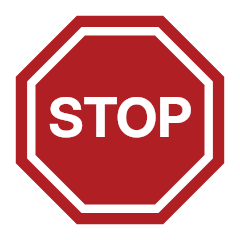
1. A stop line is painted across the pavement at this sign. Where must the vehicle come to rest?
Show answer
Answer A: Behind the stop line, with no part of the vehicle across it
The vehicle must halt behind the stop line; where no line is painted the driver stops before the crosswalk, and where there is neither, before entering the intersection.
-
2. You are about to pass another vehicle at night with your high beams on. What should you do?
Show answer
Answer C: Switch to low beams as you come up behind it and while you are alongside
High beams shining into the mirrors of the vehicle ahead blind the very driver whose reaction you depend on during the pass.
-
3. Your vehicle has daytime running lights. Why should you still switch on the headlights at dusk?
Show answer
Answer B: Daytime running lights usually do not light the tail lights, so you are hard to see from behind
On many vehicles the daytime running lights illuminate only the front. Without the headlight switch on, the rear of the vehicle stays dark and the dash may still look lit.
-
4. Your vehicle is burning at the roadside. How far away should everyone keep?
Show answer
Answer D: At least a hundred feet away from the vehicle and upwind, out of the drifting smoke
Burning vehicles give off toxic smoke and parts such as tires and struts can burst, so keep a long distance and stay upwind.
-
5. Where is a road work ahead sign placed?
Show answer
Answer B: In advance of the work space or detour, so drivers are warned before reaching it
Advance warning signs are placed upstream of the work space or detour so that drivers have time to slow down and change lanes before reaching the activity.
-
6. The low sun is directly ahead and glare makes it hard to see. What should you do?
Show answer
Answer C: Slow down, use the sun visor or sunglasses, and increase following distance
Sun glare can hide pedestrians, brake lights and signals. Reducing speed and adding space gives you time to react to what you cannot yet see.
-
7. A steady red arrow is displayed for your left-turn lane at a two-way intersection. What must you do?
Show answer
Answer C: Stop and remain stopped until an indication permits the turn
A steady red arrow prohibits the movement it points to, so the driver stops and waits for a green arrow, a flashing yellow arrow or another indication that permits the turn.
-
8. Why is being thrown out of a vehicle in a crash so dangerous?
Show answer
Answer C: Because you strike the road or other objects at high speed, and rarely survive
Ejection is one of the deadliest outcomes of a crash, and a fastened belt is what keeps a person inside the vehicle.
-
9. What is the first thing to do once your disabled vehicle is stopped on the shoulder?
Show answer
Answer A: Switch on the hazard warning lights so other drivers can see the vehicle
Hazard lights are the fastest way to make a stopped vehicle visible, and everything else can follow once traffic has been warned.
-
10. How much of a traffic lane is a motorcycle entitled to use?
Show answer
Answer D: The full width of the lane
A motorcycle is entitled to the full lane, and riders move within it to stay visible and to avoid surface hazards, so drivers should never try to share a lane with one.
-
11. You realize you have turned the wrong way onto a one-way street. What should you do?
Show answer
Answer A: Pull to the right, stop, and back into the street you came from when clear
Get out of the traffic stream first: pull right and stop, then back out into the street you came from once you can see it is safe.
-
12. You are about to pass a large truck on a two-lane highway. Which practice is correct?
Show answer
Answer A: Finish the pass without delay and expect wind turbulence beside the truck
Lingering beside a truck keeps you in its blind spot and exposes you to air turbulence. Pass on the left, keep moving, and move back only when you can see the whole truck in your mirror.
-
13. At a railroad crossing with no gates and no flashing lights, the crossbuck is normally combined with which sign?
Show answer
Answer C: A yield sign, or a stop sign where an engineering study calls for one
At a passive crossing the crossbuck forms an assembly with a yield sign, or with a stop sign when an engineering study or engineering judgment supports it, so the driver knows who must give way to the train.
-
14. Federal law lets a state open its high-occupancy vehicle lanes to certain vehicles carrying only one person. Which of these is covered by that allowance?
Show answer
Answer B: Motorcycles
Federal law lets states allow motorcycles into high-occupancy vehicle lanes regardless of the number of occupants, because keeping riders in the flow is safer than the alternative.
-
15. At what breath alcohol concentration does a Minnesota ignition interlock device block the engine from starting?
Show answer
Answer A: 0.02 or higher
Minnesota Statutes 171.306 defines the device as one that prevents ignition when the breath alcohol concentration measures 0.02 or higher.
-
16. Within what period after driving can a test result still establish a Minnesota impaired driving offense?
Show answer
Answer A: Two hours
Minnesota Statutes 169A.20 counts an alcohol concentration measured at the time of driving or within two hours of that time.
-
17. Is it safe to check your phone while stopped at a red light?
Show answer
Answer B: No, you may miss the signal change and hazards around you
Attention does not return instantly when the light changes, and emergency vehicles, pedestrians or a rear-end threat can appear while you are stopped. Stay focused on the road.
-
18. What is the correct relationship between air bags and seat belts?
Show answer
Answer B: Air bags are designed to work together with seat belts, not instead of them
An air bag is a supplemental restraint that cushions one impact, while the belt keeps you in position so the bag can work and protects you in rollovers and secondary impacts.
-
19. At an intersection where turning right on red is permitted and no sign prohibits it, what must you do before turning?
Show answer
Answer A: Come to a complete stop and yield to pedestrians and cross traffic
A right turn on red is allowed only after a full stop, and the turning driver must yield to pedestrians in the crosswalk and to traffic already using the intersection.
-
20. Your wiper blades smear the windshield instead of clearing it. What should you do?
Show answer
Answer C: Replace the blades, because smearing means that the rubber is worn
Worn or hardened rubber cannot wipe cleanly, and blades are cheap compared with driving without a clear view.
-
21. A vehicle in the lane beside you has stopped at a crosswalk. What should you do?
Show answer
Answer C: Stop as well, because that driver may be yielding to a pedestrian you cannot see
The stopped vehicle hides the crosswalk from you, and passing it is a leading cause of collisions with pedestrians who are already crossing.
-
22. In Minnesota, who pays the fine when a 12-year-old passenger is riding unbelted?
Show answer
Answer C: The driver, who is fined 25 dollars for each such passenger
Minnesota Statutes 169.686 makes the driver liable for a 25 dollar fine for each unbelted passenger under the age of 15, while passengers 15 and older are fined themselves.
-
23. You are about to pass a long tractor-trailer on a two-lane road. What should you expect?
Show answer
Answer B: You will need more clear road, since the vehicle is much longer
A tractor-trailer can be 70 feet long, so passing it takes more distance and more time than passing a car at the same speed difference.
-
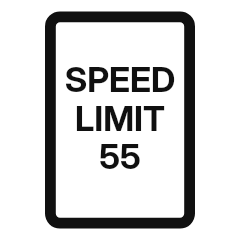
24. A driver passes this sign on an open road. Over what stretch does the figure it sets stay in force?
Show answer
Answer A: From the sign onward, in every lane, until another sign sets a different figure
The figure governs the road from the sign onward and binds every lane, and it stays in force until a later sign sets a different one.
-
25. How often should you check your mirrors while driving?
Show answer
Answer C: Every few seconds, so you always know what is around you
Traffic behind and beside you changes constantly. Frequent, brief mirror checks keep a picture of your surroundings current so nothing surprises you.
-
26. A vehicle is sitting in your blind spot and you need to change into that lane. What should you do?
Show answer
Answer B: Adjust your speed to open a clear gap, then check again and move over
Changing your speed either drops the other vehicle behind you or lets it move ahead, which turns the blind spot back into open space.
-
27. Why should you set the parking brake even when an automatic transmission is in Park?
Show answer
Answer B: Because it takes the strain off the transmission and holds the vehicle
The parking pawl is a small part carrying the whole vehicle; the parking brake shares that load and holds the vehicle if the pawl fails.
-
28. You turn left onto a road that has a center two-way left-turn lane. In which lane should you be traveling once the turn is finished?
Show answer
Answer D: The first through lane to the right of the center turn lane
The shared center lane is only for turning movements, so even where a state lets you pause in it to merge you must end up in the first ordinary travel lane beside it.
-
29. You notice a bulge on the sidewall of one of your tires. What should you do?
Show answer
Answer D: Have the tire replaced before driving far, because it could blow out
A sidewall bulge means the internal cords have broken and only the rubber is holding the air. The tire can fail suddenly at any speed.
-
30. You are driving along a street lined with parked cars. What should you watch for?
Show answer
Answer B: Doors opening, vehicles pulling out and pedestrians stepping from between cars
Parked cars hide people and can move without warning. Keep as much space from them as you safely can and cover the brake.
-
31. When should you turn on your signal before a turn or a lane change?
Show answer
Answer C: Well before the maneuver, so other drivers have time to react
A signal is a warning to others, so it has to be given far enough ahead of the maneuver that drivers and pedestrians can adjust.
-
32. What Minnesota speed limit applies where no other statutory limit and no posted limit applies?
Show answer
Answer D: 55 mph
Minnesota Statutes 169.14 sets 55 miles per hour in locations other than those the section specifically lists.
-
33. A yellow horizontal rectangular sign showing one large arrow pointing left or right, facing traffic on the far side of a sharp bend, tells the driver
Show answer
Answer C: which way the roadway turns at that point
The large arrow sign is mounted on the outside of a sharp change in alignment so that a driver approaching head on immediately sees which way the road goes.
-
34. What reinstatement fee applies after an alcohol-related license revocation in Minnesota?
Show answer
Answer C: 680 dollars
Minnesota charges a 680 dollar reinstatement fee for an alcohol-related revocation, in addition to reapplying and possibly entering the Ignition Interlock Device Program.
-
35. You are approaching a sharp curve. When should you reduce your speed?
Show answer
Answer D: Before you enter the curve, so you can accelerate gently through it
Braking hard inside a curve uses up the traction that is already being demanded for cornering, so the slowing must be finished before you enter.
-
36. Your brake pedal sinks to the floor and the vehicle does not slow down. What is a reasonable sequence of actions?
Show answer
Answer C: Pump the pedal, shift to a lower gear and apply the parking brake gradually while steering to a safe spot
Pumping can rebuild pressure in a partly failed system, a lower gear adds engine braking, and easing on the parking brake slows the vehicle without locking the wheels.
-
37. You are in the acceleration lane and the gap you were aiming for is now beside you. What is the best adjustment?
Show answer
Answer A: Change your speed a little to line up with a gap, then merge smoothly
The acceleration lane is for matching both the speed and the position of a gap, and small speed adjustments are what line the two up.
-
38. You have just merged onto a freeway from an entrance ramp. What should you do next?
Show answer
Answer C: Settle into the right lane and build up speed before changing lanes
Crossing lanes while you are still below the speed of the traffic forces other drivers to brake, so the speed comes first and the lane change second.
-
39. Some drivers believe they can multitask while driving. What does research show?
Show answer
Answer C: The brain switches rapidly between tasks and driving performance suffers
The brain does not truly do two attention-demanding tasks at once; it alternates between them, and the driving task gets less attention each time.
-
40. You are approaching the entry of a roundabout and a pedestrian is crossing the marked crosswalk on your approach lane. What must you do?
Show answer
Answer D: Stop before the crosswalk and let the pedestrian cross
Roundabout crosswalks sit a short distance back from the yield line, and drivers must yield there before they ever reach the circulating lanes.