
Minnesota DVS Permit Practice Test 17
- Questions40
- Correct to pass32
- Passing score80%
- Minimum age15 years
-
1. You are about to open your door after parking on the traffic side of the street. What should you do first?
Show answer
Answer C: Check the mirror and look back for approaching vehicles and bicyclists before opening the door
A door opened into traffic can strike a passing bicyclist or vehicle, so you check behind you first and keep the door open no longer than necessary.
-
2. You are approaching a highway-rail grade crossing marked only with a crossbuck sign. What does that sign require?
Show answer
Answer A: Yield to any approaching train and cross only when the tracks are clear
The crossbuck is a regulatory yield sign, and a train can never stop or steer around a vehicle, so the driver must always give way.
-
3. A crossing guard steps into the roadway ahead of this sign with one hand raised. What must the driver do?

Show answer
Answer B: Stop and stay stopped until the guard waves traffic on
An adult guard is controlling traffic at that crossing, so the instruction given by that person governs and the driver waits to be released.
-
4. You come around a bend and find loose sand spread across your lane. What should you do?
Show answer
Answer D: Ease off the gas, avoid sudden braking or steering, and keep straight
Loose material acts like ball bearings under the tires; smooth inputs preserve what little grip remains, while sudden braking or steering breaks it.
-
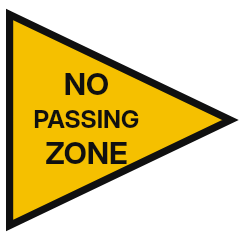
5. Why would a restriction like this one be applied to a stretch of road?
Show answer
Answer A: Because there is not enough visible road ahead to complete a pass safely
Limits on overtaking are set where a hill, a curve or an obstruction leaves too little sight distance for a driver to pull out, pass and return before meeting oncoming traffic.
-
6. When is it acceptable to reach into the back seat for something while driving?
Show answer
Answer A: Never; stop somewhere safe instead
Twisting round takes your eyes off the road and your control of the wheel with it, so anything in the back seat waits until the car is stopped.
-
7. What are painted curb markings mainly used for?
Show answer
Answer D: Conveying parking and stopping regulations
Colored curbs tell drivers where waiting or parking is restricted, and because the exact color meanings are set locally a driver should also read the posted signs.
-
8. You are driving through patchy fog on a highway. What should you be ready for?
Show answer
Answer B: Sudden dense banks where visibility drops within a few car lengths
Patchy fog can go from clear to nearly blind in a moment, so keep your speed low enough that a sudden bank does not leave you without room.
-
9. You notice at night that one of your headlights has burned out. What should you do?
Show answer
Answer B: Get it replaced promptly, because other drivers may take you for a motorcycle
A single light makes your vehicle look narrower and further away, so other drivers misjudge you, and one light is also illegal.
-
10. You are using the parking brake to slow a vehicle whose brakes have failed. How should you apply it?
Show answer
Answer D: Gradually, holding the release so you can let it off if the rear slides
The parking brake works on two wheels only, so applying it hard can lock them and spin the vehicle. Keep the release held so you can back it off instantly.
-
11. You and an opposing driver reach a four-way stop at the same time and both of you are turning right. What should happen?
Show answer
Answer C: Both may turn at the same time into their own lanes
Two opposing right turns take drivers into different lanes without crossing, so both can proceed together once pedestrians are clear.
-
12. It is cold and the road looks wet, but you notice the tires of vehicles ahead are throwing up no spray. What does this suggest?
Show answer
Answer B: The surface has frozen and is probably icy
Water throws spray, but ice does not. A shiny road with no spray in freezing temperatures is a strong sign of black ice, so slow down and avoid sudden inputs.
-
13. A small plate under a stop sign reads CROSS TRAFFIC DOES NOT STOP. What is it telling you?
Show answer
Answer D: Traffic on the cross street is not required to stop at all
The plate warns that the other road is uncontrolled, so you must wait for a gap instead of expecting anyone to take turns with you.
-
14. You want to move into the right lane just as an entrance ramp joins the highway at that point. What is the better choice?
Show answer
Answer B: Wait until you are past the merge area so you do not squeeze the entering traffic
The merge area is where ramp traffic has to find a gap, so adding a lane change of your own into the same space creates a conflict.
-
15. What does a NARROW BRIDGE warning sign tell a driver?
Show answer
Answer A: The bridge is tighter than the road leading up to it
A narrow bridge still carries both directions, but with much less clearance than the approaches, so drivers should slow and hold their lane position carefully.
-
16. Which passengers do not count against the Minnesota provisional license passenger limit?
Show answer
Answer A: Members of the driver's immediate family
The statute limits passengers under 20 who are not members of the license holder's immediate family.
-
17. Well before an intersection, an overhead sign shows a diagram of the lanes with an arrow above each one. What is its purpose?
Show answer
Answer C: To let drivers pick the correct lane in good time
Advance intersection lane control signs display the lane assignment far enough back that drivers can move over calmly instead of at the last moment.
-
18. Your left-turn lane faces a steady green ball and oncoming traffic is heavy. What are you allowed to do?
Show answer
Answer C: Move into the intersection and turn when a safe gap appears
A green ball permits the turn but gives no priority, so you may move into the intersection and wait there for a gap in the oncoming traffic.
-
19. A school sign paired with a plaque showing a diagonal downward-pointing arrow is installed
Show answer
Answer D: at the school crossing itself, or as close to it as possible
The diagonal downward arrow points at the crossing, so this assembly is placed at the crossing location rather than in advance of it.
-
20. You feel fine twenty minutes after your last drink. Why is that a poor guide to driving?
Show answer
Answer B: Your blood alcohol level can still be rising
Alcohol keeps being absorbed for some time after the last drink, so a driver who feels able at the door can be more impaired a few miles down the road.
-
21. On a Minnesota two-lane highway posted at 55 mph or higher, what happens to the limit while lawfully passing another vehicle?
Show answer
Answer C: It increases by 10 mph
Minnesota allows a driver to exceed the posted limit by 10 mph while lawfully passing another vehicle traveling in the same direction on a two-lane highway posted at 55 mph or more.
-
22. You leave your car so that its rear overhangs a marked crosswalk. What is wrong with that?
Show answer
Answer B: Pedestrians must step around it into the traffic lane
A crosswalk has to stay completely clear; anything sticking into it pushes people on foot out into the path of moving vehicles.
-
23. An orange background with a black legend on a sign indicates
Show answer
Answer B: a temporary traffic control or work zone situation
Orange is reserved for temporary traffic control signing, so an orange sign means conditions have been altered for work or another temporary operation.
-
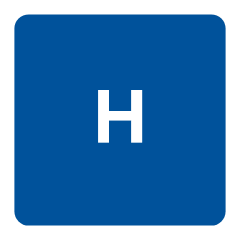
24. Which of these is announced with the same family of signs as the facility shown here?
Show answer
Answer A: A rest area for travelers
A rest area belongs to the same motorist service series, which points travelers toward facilities such as fuel, food, lodging and medical care.
-
25. Which facility does this sign direct a traveler toward?
Show answer
Answer B: A hospital offering emergency care
This is the standard marker for medical care, used to lead a traveler to a hospital where emergency treatment is available.
-
26. Your vehicle has broken down at night on a rural road and your phone has no signal. What is the safest thing to do?
Show answer
Answer C: Stay with the vehicle, keep the hazard lights on and wait for help
A lit vehicle is far easier to find than a person walking in the dark, and running the engine while you sleep risks carbon monoxide.
-
27. Your engine stalls while you are driving in traffic. What is the correct response?
Show answer
Answer A: Shift to neutral, try to restart it, and steer and brake toward the side of the road
With the engine off, power steering and power brake assistance fade, so steering and braking take more effort but still work. Neutral lets you attempt a restart while you coast to safety.
-
28. How far ahead should you normally be looking as you drive?
Show answer
Answer C: About 12 to 15 seconds ahead, well beyond the vehicle in front
Looking that far down the road lets you see a problem developing and slow smoothly, instead of discovering it in time only for hard braking.
-
29. You have loaded the trunk heavily. Why might oncoming drivers flash their lights at you at night?
Show answer
Answer D: The rear sits lower, so your headlights point higher and dazzle them
Weight in the back tips the vehicle nose up and lifts the beam pattern, so low beams shine into the eyes of drivers coming the other way.
-
30. What is the minimum age for a Minnesota provisional license?
Show answer
Answer D: 16 years old
A Minnesota provisional license may be issued at age 16 once driver education, the permit period, the driving log and the road test are complete.
-
31. A yellow sign ahead of an underpass reads LOW CLEARANCE 12 FT 6 IN. What does the figure tell you?
Show answer
Answer B: The greatest height that can pass beneath the structure
The figure is the actual clearance available, so a vehicle taller than that must leave the road and take a marked alternative route.
-
32. You are parking on a one-way street where parking is allowed on both sides. What must still be true?
Show answer
Answer D: The vehicle must face the direction the traffic flows
Either curb may be used on a one-way street where signs allow it, but the vehicle must always be headed in the direction traffic moves.
-
33. A pedestrian starts to cross against a Do Not Walk signal, right in front of you. What should you do?
Show answer
Answer D: Slow or stop and let the person reach safety
Even when a pedestrian is crossing unlawfully, a driver must take reasonable care to avoid hitting that person.
-
34. Which of these is part of preparing a vehicle for winter driving?
Show answer
Answer A: Fitting good tires and using washer fluid that will not freeze
Winter readiness means tread, battery, wipers, antifreeze and washer fluid rated for the cold, plus a reasonable amount of fuel in the tank.
-
35. The only person offering you a ride home has been drinking. What should you do?
Show answer
Answer B: Do not get in; find another way home
A passenger in an impaired driver's vehicle shares all of the risk and can do nothing about it from the seat, so the only safe answer is another ride.
-
36. What is the longest period for which Minnesota may suspend a driver's license?
Show answer
Answer C: One year
Minnesota Statutes 171.18 provides that the department must not suspend a license for a period of more than one year.
-
37. What does a sign reading Slower Traffic Keep Right require?
Show answer
Answer C: Traffic moving slower than the general flow must use the right-hand lane
The sign applies to any vehicle traveling below the speed of the traffic around it, which must keep right so faster vehicles can use the lanes to the left.
-
38. A driver extends the left arm out the window and bends it upward at the elbow. What does this signal mean?
Show answer
Answer B: A right turn
The left arm bent upward at the elbow is the standard hand signal for a right turn.
-
39. You get into a heated argument with a passenger while driving. What should you do?
Show answer
Answer D: End the discussion or pull over to finish it
Anger narrows attention and encourages risk, and a conversation you cannot let go of is a passenger you should be parked to talk with.
-
40. A preferential lane sign reads HOV 2+ and lists the hours it applies. During those hours, which vehicles may use the lane?
Show answer
Answer A: Vehicles carrying at least two people, counting the driver
The number on an HOV sign is the minimum number of occupants, driver included, that a vehicle must carry to use the lane while the restriction is in effect.