
Minnesota DVS Permit Practice Test 24
- Questions40
- Correct to pass32
- Passing score80%
- Minimum age15 years
-
1. You arrive at an intersection with no signs, no signals and no markings at the same time as a vehicle on the road to your right. What must you do?
Show answer
Answer B: Yield to the vehicle on your right
At an uncontrolled intersection you must yield to a vehicle already in the intersection or approaching from your right.
-
2. Which vehicle may be driven in Minnesota with only a class D driver's license?
Show answer
Answer B: A single-unit vehicle with a gross vehicle weight rating under 26,000 pounds
Class D is Minnesota's ordinary license and covers single-unit vehicles under 26,000 pounds, along with farm trucks and recreational vehicles within the limits the statute sets.
-
3. Some states allow a left turn against a red light. Which movement is it?
Show answer
Answer A: A left turn from a one-way street onto another one-way street
The movement generally allowed on red is one-way to one-way, because the turn does not cross any lane of oncoming traffic; a few states also extend it to a two-way street turning onto a one-way street.
-
4. What does a yield sign require of a driver?
Show answer
Answer A: Slow down, and stop when necessary, so conflicting traffic can go first
A yield sign obliges the driver to reduce to a speed suited to conditions and to stop when needed so that conflicting traffic or pedestrians are not interfered with.
-
5. The trailer you are towing begins to sway from side to side at highway speed. What should you do?
Show answer
Answer D: Ease off the accelerator, hold the wheel steady and let the speed drop
Sway grows with speed and with sudden inputs. Reducing speed gently while keeping the steering steady lets the trailer settle behind you.
-
6. A school crossing guard has returned to the curb but two children are still walking across the road. When may you go?
Show answer
Answer C: Only after the children have reached the far sidewalk
The guard leaving the road does not end your duty; you stay stopped until every child is clear of the roadway.
-
7. You come upon a crash that has just happened and decide to help. Where should you stop your vehicle?
Show answer
Answer A: Well beyond the scene, completely off the road, with the hazard lights on
Stopping past the crash and off the pavement keeps you from becoming another victim and leaves the approach clear for emergency vehicles.
-
8. You are turning right where a paved trail crosses the road just past the corner. What should you look for?
Show answer
Answer B: Cyclists and walkers arriving from either direction on the trail
A shared use path carries two-way traffic on foot and on bicycles, so scan both directions along the trail before crossing it.
-
9. You are parking facing downhill on a street with a curb. Which way should the front wheels point?
Show answer
Answer A: Toward the curb, so the vehicle would roll into it if it moved
Turning the wheels toward the curb when facing downhill means a vehicle that starts to roll is stopped by the curb instead of entering the traffic lane.
-
10. A lane control sign over one lane shows both a straight arrow and a left arrow. What does it tell drivers in that lane?
Show answer
Answer A: Either movement may be made from that lane
An optional movement lane control sign lists every movement permitted from the lane, so a driver may choose any arrow shown.
-
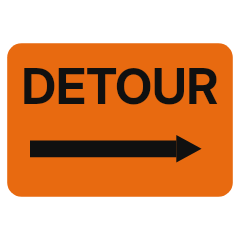
11. Once a driver has joined the route this sign begins, how is the rest of the way marked?
Show answer
Answer B: By further markers of the same kind at each turn, until the original road is rejoined
The alternate route is signed continuously, with a marker at every turn, so a driver with no local knowledge can follow it back to the original road.
-
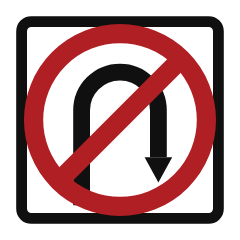
12. A driver who wants to reverse direction arrives at this sign. What is allowed?
Show answer
Answer C: Going on and reversing direction only where the maneuver is permitted
The restriction removes that maneuver at that spot entirely, so the driver has to continue and turn the vehicle around at a place where it is not prohibited.
-
13. You have turned onto a ramp at night and your headlights pick out large white arrows painted on the pavement pointing straight back at you. What do they mean?
Show answer
Answer C: You are traveling against the flow and must turn back
Wrong-way arrows are laid so that a driver going the correct way never sees them head on, so an arrow pointing at you means you are on the ramp backwards.
-
14. You are in a minor collision on a busy road. No one is hurt and both vehicles can be driven. What is the recommended thing to do?
Show answer
Answer C: Move the vehicles out of the travel lanes to a safe spot before exchanging information
Vehicles left in traffic after a minor crash invite a second, often worse, collision. Clearing the lane protects everyone, and you still exchange details and report as required.
-
15. A child has outgrown the rear-facing seat. What comes next?
Show answer
Answer D: A forward-facing seat with a harness, used up to its own stated limits
The stages run rear facing, then forward facing with a harness, then a booster, then the adult belt alone.
-
16. What color scheme does a standard stop sign use?
Show answer
Answer B: White legend and border on a red background
The stop sign carries a white legend and border on a red background, the color set aside for stop, yield and prohibition messages.
-
17. You are about to leave a roundabout when a pedestrian steps into the crosswalk on your exit. What should you do?
Show answer
Answer B: Yield to the pedestrian and wait for the crosswalk to clear
Roundabout crosswalks sit on the entries and exits, and drivers must yield to pedestrians using them.
-
18. When may you stop on the shoulder of a freeway?
Show answer
Answer A: Only in an emergency, moving completely off the travel lanes and switching on your hazard lights
The freeway shoulder is reserved for emergencies and for disabled vehicles, and a vehicle stopped there must be clear of the travel lanes with hazard lights on.
-
19. A white regulatory sign shows the silhouette of a truck inside a red circle with a diagonal slash. What does it mean?
Show answer
Answer A: Trucks are not allowed to use that road
The circle and slash over a symbol always means the movement or vehicle shown is prohibited, so trucks must keep off that roadway.
-
20. A trailer that sways badly at speed is often loaded the wrong way. What is the usual fault?
Show answer
Answer A: Too much of the load sits behind the trailer axle
Weight behind the axle lightens the hitch and lets the trailer wag the vehicle. Most of the load should sit ahead of the axle to keep weight on the hitch.
-
21. A pedestrian has stepped into a crosswalk at an intersection ahead of you. What is your obligation?
Show answer
Answer C: Yield and let the pedestrian finish crossing before you proceed
Drivers must yield to pedestrians in a crosswalk, and an intersection has a legal crosswalk whether or not lines are painted on the pavement.
-
22. You are stopped at a steady red arrow pointing right, and no sign or state rule permits turning on a red arrow. May you turn right?
Show answer
Answer A: No, you must wait until the red arrow goes out and a green signal appears
A steady red arrow prohibits the movement it points to until a signal permitting it appears. Only a posted sign or a specific state rule allows a turn on a red arrow after a complete stop, so without one you must wait.
-
23. You back into an unattended parked car in a lot and cause visible damage. What must you do?
Show answer
Answer A: Try to find the owner, or leave a note with your name and contact details, and report the crash
Hitting an unattended vehicle carries the same duties as any crash. Leaving without identifying yourself is a hit-and-run offense.
-
24. You are descending a long steep grade with a loaded truck close behind you. What should you do?
Show answer
Answer A: Hold a steady speed and let it pass when it can
Gravity pushes a loaded truck downhill and it cannot slow quickly, so give it a predictable speed and room to get by rather than braking in front of it.
-
25. You must slow suddenly on a highway and a vehicle is following close behind you. What helps prevent a rear-end collision?
Show answer
Answer D: Tapping the brake pedal early so your brake lights flash a warning
Early brake light flashes give the driver behind more time to react, and slowing gradually instead of suddenly reduces the chance of being struck.
-
26. An orange sign reads RIGHT LANE CLOSED AHEAD. What is the correct response?
Show answer
Answer A: Move left in good time and keep a steady pace
The sign is placed well before the taper so that drivers can merge smoothly rather than braking hard where the lane actually closes.
-
27. Under Vanessa's Law, when can a Minnesota driver under 18 regain driving privileges revoked for a crash or an alcohol or controlled substance violation?
Show answer
Answer C: Not until the driver turns 18
Vanessa's Law prevents a driver revoked before age 18 for a crash-related moving violation or an alcohol or controlled substance violation from regaining driving privileges until reaching age 18.
-
28. Which of the four blind spots around a tractor-trailer is the largest?
Show answer
Answer A: The one on the right side of the truck
A truck has no-zones on all four sides, and the right-side blind spot is the largest because it runs back along the trailer and reaches across more than one lane.
-
29. You have started to pass and you see the no-passing zone beginning ahead. What should you do?
Show answer
Answer D: Ease off, drop back and return to your own lane
A pass must be completed before the no-passing zone starts. If it will not fit, abandon it and slot back in behind.
-
30. You are stopped at a stop sign on a two-way stop intersection and the cross street has no stop signs at all. What does that mean for you?
Show answer
Answer A: You yield to all cross traffic no matter how long that takes
At a two-way stop only your direction is controlled, so there is no taking turns; you wait for a gap big enough to enter safely.
-
31. The vehicle in front of you has stopped and is waiting to turn left, and there is a paved shoulder to the right. May you use it to get by?
Show answer
Answer D: No, in most states a pass may not be made by leaving the paved travel lanes
Passing on the right is normally lawful only inside the marked travel lanes, and most states prohibit driving onto the shoulder to get around a turning vehicle; the few states that allow it attach strict conditions.
-
32. A black and white regulatory sign facing traffic at a divided section reads KEEP LEFT. What does it require?
Show answer
Answer D: Passing the island or obstruction on its left side
Keep Left is posted at an island or obstruction that traffic must pass on the left, which is the opposite of the far more common Keep Right situation.
-
33. Why is being predictable an important part of driving safely?
Show answer
Answer A: Because other road users are able to plan around what you are doing
Other drivers make their decisions from what they expect you to do, so surprises are what produce collisions.
-
34. What do the numbers on a pedestrian countdown display show?
Show answer
Answer A: The seconds remaining to finish a crossing already under way
The countdown runs during the pedestrian change interval and shows how many seconds are left before the crossing time ends.
-
35. Your power steering fails while you are driving. What happens and what should you do?
Show answer
Answer B: Steering becomes much harder but still works, so slow down and pull off the road
Without power assistance the steering still works, but it takes much more effort, especially at low speed. Keep both hands on the wheel and get off the road.
-
36. Is it acceptable to drive with your vehicle straddling the line between two lanes?
Show answer
Answer D: No, you must drive as nearly as practical entirely within a single lane
A vehicle astride the line takes up two lanes and leaves the drivers around it unable to predict where it will go.
-
37. You are calling 911 to report a crash. Which information matters most?
Show answer
Answer C: The exact location, how many people are hurt and any hazard such as fire
Dispatchers need to know where to send help, how much help to send, and what dangers the crews will meet on arrival.
-
38. Smoke and flames appear from the engine compartment after you stop. What should you do?
Show answer
Answer A: Get everyone well away from the vehicle first, and then call the fire service
A vehicle fire can spread within seconds, so people come out first and firefighting is left to the fire service.
-
39. A lane along the right edge is set off by a solid white line and marked with a bicycle symbol. How should a driver treat it?
Show answer
Answer B: Stay out of it except for the short distance needed to turn or cross where that is allowed
A marked bicycle lane is set aside for bicycle traffic, and motor vehicles may enter it only briefly where turning or crossing is permitted.
-
40. A regulatory sign reads TURN ON HEADLIGHTS NEXT 15 MILES. What does it require?
Show answer
Answer C: Low beam headlights on for that stretch, day or night
Such a section is signed where a road is hard to see along, and the requirement is to run headlights, not just daytime running lamps, through the whole stretch even in bright daylight.