
Minnesota DVS Permit Practice Test 26
- Questions40
- Correct to pass32
- Passing score80%
- Minimum age15 years
-
1. A sign at the start of an exit ramp shows a speed much lower than the highway limit. What does it apply to?
Show answer
Answer C: The curve of the ramp itself, once you have left the highway
The ramp speed is set by the sharpness of the ramp curve, so you slow to it inside the deceleration lane rather than out on the highway.
-
2. Cones and drums mark a shifted lane through a work zone. What should you do?
Show answer
Answer A: Follow the path that they mark and stay inside it
Channelizing devices define the temporary travel path, and the space on the other side of them belongs to the workers.
-
3. The vehicle you have borrowed is larger and heavier than your own. How should you drive it?
Show answer
Answer B: Allow more room for stopping and for turns until you are used to it
Extra weight and length mean longer stopping distances and wider turns, so give yourself more room until you are used to it.
-
4. Beside an accessible parking space there is an area painted with diagonal stripes. What is it for?
Show answer
Answer C: It is an access aisle for wheelchairs and lifts, and no vehicle may park or stop in it
The striped access aisle gives the room a ramp or lift needs to deploy, so blocking it makes the adjacent accessible space unusable.
-
5. An arrow panel in a work zone shows four flashing lamps in caution mode instead of an arrow. What does that display mean?
Show answer
Answer A: Warning only, so pass the work area with caution in your current lane
Caution mode gives a general warning without directing a lane change, so drivers stay alert and pass the activity with care.
-
6. A line beside your lane is painted about twice the normal width. What does the extra width convey?
Show answer
Answer B: Greater emphasis on the restriction it carries
Width is part of the marking code: a wide line carries more emphasis than a normal one, which is why it is used at gores and channelizing lines.
-
7. How does going a long time without sleep compare with drinking?
Show answer
Answer A: It can impair a driver in much the same way
Long periods awake produce slow reactions, poor judgment and lapses of attention that resemble the effects of alcohol, which is why fatigue counts as impairment.
-
8. On a busy multilane highway, where is the best place to travel?
Show answer
Answer B: In a gap in the traffic, with space open on both sides
Travelling in a gap keeps escape routes open on both sides, while riding alongside other vehicles removes the room you would need to swerve.
-
9. A large panel mounted on a trailer at the roadside displays a flashing arrow pointing left. What does it tell you?
Show answer
Answer B: Move into the lane to your left
An arrow panel directs traffic out of a closed lane, so the arrow shows the direction you must move rather than the shape of the road ahead.
-
10. How long is a Minnesota instruction permit issued to an applicant aged 18 or older valid?
Show answer
Answer C: Two years
Minnesota Statutes 171.05 makes the adult instruction permit valid for two years, with renewal available.
-
11. Who is exempt from Minnesota's hands-free law while performing official duties?
Show answer
Answer A: The operator of an authorized emergency vehicle
Minnesota Statutes 169.475 excepts the operator of an authorized emergency vehicle acting in the course of official duties.
-
12. You want to turn right from a lane marked for through traffic and right turns, and the driver behind you wants to go straight. What should you do?
Show answer
Answer C: Signal, stay in the lane and make the turn when it is safe
A shared lane is the correct place to turn right from, so signal early and turn from the lane; the driver behind must wait or use another lane.
-
13. How must a child who is 18 months old be transported in Minnesota?
Show answer
Answer B: In a rear-facing child restraint with an internal harness
Minnesota Statutes 169.685 requires a child under the age of two to ride in a rear-facing child passenger restraint system with an internal harness until the child reaches the seat's weight or height limit.
-
14. A yellow sign shows a truck on a slope with the legend 7 PERCENT GRADE. What should a driver of a heavy vehicle do?
Show answer
Answer A: Select a lower gear before starting down
The percentage shows how steep the descent is, and choosing a low gear at the top lets the engine hold the vehicle back instead of the brakes overheating.
-
15. Which color scheme is standard for the drums and barricades that channel traffic through a work zone?
Show answer
Answer C: Alternating orange and white retroreflective stripes
Drums and barricades carry alternating orange and white retroreflective stripes, and the traffic cones used in the same zones are predominantly orange.
-
16. An emergency vehicle with flashing lights and a siren is approaching from behind on a two-way street. What should you do?
Show answer
Answer C: Pull over to the right edge of the road and stop until it passes
Clearing a path by pulling to the right and stopping gives the emergency vehicle a predictable route, while stopping in mid-lane or inside an intersection blocks that path.
-
17. You are parking on a hill where there is no curb, whether facing up or down. Which way should the front wheels point?
Show answer
Answer B: Toward the shoulder, so the vehicle would roll away from the traffic lanes
With no curb to stop the vehicle, the wheels are turned toward the edge of the road so that a runaway vehicle leaves the roadway instead of entering it.
-
18. You turn the wheel but the front of the vehicle keeps sliding straight ahead on a slippery road. What should you do?
Show answer
Answer C: Ease off the accelerator and reduce the steering angle until the front tires grip again
A front-wheel skid means the tires are asking for more grip than the surface can give. Less speed and less steering angle let them regain traction.
-
19. A yellow pennant, an isosceles triangle with its long axis horizontal, is reserved for which message?
Show answer
Answer D: No passing zone
The pennant shape is used only for the no passing zone sign, which marks the point where overtaking is no longer allowed.
-
20. A parking space is marked with the international symbol of access. Who may use it?
Show answer
Answer A: Only a vehicle displaying the required placard or plate
Accessible spaces may be used only by a vehicle that displays a valid disability placard or plate, no matter how short the stop would be.
-
21. The red oil pressure warning light comes on while you are driving. What should you do?
Show answer
Answer C: Pull over safely as soon as possible and shut off the engine
Loss of oil pressure means the engine is no longer being lubricated and can be destroyed within minutes. Stop, shut down and check before restarting.
-
22. What is a marked loading zone for?
Show answer
Answer A: Loading and unloading only, not for general parking
A loading zone is reserved for actively loading or unloading goods or passengers; leaving a vehicle there for other reasons is a parking violation.
-
23. What is the purpose of a wide solid white line painted straight across your lane on the approach to an intersection?
Show answer
Answer C: It shows the point where a required stop must be made
A stop line indicates the point at which the stop required by a signal or a stop sign is to be made, ahead of the crosswalk and the intersection.
-
24. How much should you normally reduce your speed on a road covered with packed snow compared with dry conditions?
Show answer
Answer C: By about half
Packed snow roughly doubles the distance needed to stop, so a common guideline is to cut speed by about half. On ice, slow to a crawl.
-
25. You are turning left into a street that is divided by a raised median. Which side should you enter?
Show answer
Answer C: The right-hand roadway, so that you travel on the proper side
A raised median separates two directions of travel, so the turn must be completed into the roadway carrying traffic your way.
-
26. You are driving down a parking aisle and reach the main lane that runs along the front of the store. What is the usual rule?
Show answer
Answer C: The main through lane has the right of way over the vehicles leaving the aisles
In a parking lot the wide lane that runs across the ends of the aisles works like a through road, and drivers leaving an aisle yield to it.
-
27. You have to leave a trailer parked on a slope. What extra step protects it?
Show answer
Answer D: Chock the trailer wheels as well as setting the brake
Chocks physically block the wheels, which is the only thing that still holds if a brake or a coupling lets go.
-
28. On a long, straight highway you feel your attention fading. What helps you stay alert?
Show answer
Answer A: Keep your eyes moving, scan mirrors and signs, and take regular breaks
Staring at one point brings on highway hypnosis. Active scanning keeps the mind engaged, and a break every couple of hours restores alertness.
-
29. You make eye contact with a driver waiting to pull out of a side street. What should you assume?
Show answer
Answer D: The driver may still not have seen you, so stay ready to slow or stop
Drivers can look directly at you and still not register your vehicle, especially a small one. Eye contact helps, but never rely on it.
-
30. A yellow diamond in which one line joins another at an angle warns that
Show answer
Answer B: traffic from another roadway will merge into the driver's lane ahead
The merge sign warns that another traffic stream will join the same lane ahead, so drivers on both roadways must adjust speed and spacing.
-
31. The brake warning light stays on even though the parking brake is fully released. What does it indicate?
Show answer
Answer B: A possible brake system problem, so have the brakes checked promptly
The brake warning light also signals low brake fluid or a failure in one part of the hydraulic system. Do not ignore it, because braking may be reduced.
-
32. School warning signs use which background and legend colors?
Show answer
Answer A: A black legend and border on a fluorescent yellow-green background
School warning signs carry a black legend and border on a fluorescent yellow-green background, a shade chosen so they stand out from ordinary yellow warning signs.
-
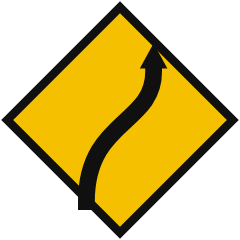
33. What does this sign tell a driver about the road ahead?
Show answer
Answer A: The roadway changes direction ahead, so speed should be reduced before reaching it
It gives advance notice of a change in alignment so the driver can slow down before entering, since braking inside a bend uses up grip that is needed for steering.
-
34. How far should the driver chest be from the steering wheel?
Show answer
Answer B: At least about ten inches
The airbag deploys with great force in the first instants of a crash, so about ten inches between your chest and the wheel is the recommended minimum.
-
35. Snow has covered the pavement markings on a two-lane road. How should a driver judge lane position?
Show answer
Answer B: By the tracks of other traffic and the roadside features
With the markings hidden, ruts left by earlier traffic, signs, poles and the line of the shoulder are the best clues to where the lane runs.
-
36. A truck ahead of you is spreading salt or grit on the road. What should you do?
Show answer
Answer B: Drop back so the material does not reach your car
Spreaders throw material backward and sideways, and following close means stone chips and a screen full of spray, so leave extra distance.
-
37. Why are sign shapes and colors standardized across the whole country?
Show answer
Answer D: So a driver knows the kind of message before reading it
Uniform shapes and colors let a driver classify a sign as regulatory, warning or guide from a distance, before the legend can be read.
-
38. Why is an underinflated tire especially risky on a long drive in hot weather?
Show answer
Answer C: It flexes more, builds up heat and can fail at speed
A soft tire flexes on every rotation, and that flexing makes heat that the hot road and high speed add to until the tire can come apart.
-
39. You reach a stretch of road covered by moving flood water of unknown depth. What is the correct decision?
Show answer
Answer D: Turn around and take another route
About a foot of moving water is enough to carry away most cars, and the roadbed under the water may already be washed out, so the only safe choice is to turn around.
-
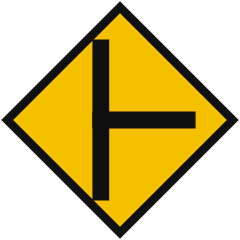
40. Approaching the point this sign refers to, which hazard is most likely?
Show answer
Answer A: A vehicle pulling out from the entering road into the driver's path
The main risk is a driver on the entering road who misjudges the gap and pulls out, so covering the brake and being ready to slow is the sensible response.