
Minnesota DVS Motorcycle Practice Test 16
- Questions40
- Correct to pass32
- Passing score80%
- Minimum age16 years
-
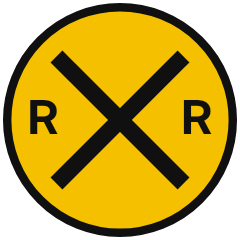
1. This sign leads to a crossing that has no gates and no flashing lights. What does that mean for the driver?
Show answer
Answer D: Nothing will warn of an approaching train, so the driver must check the tracks personally
At a passive crossing there is no active device to announce a train, so the whole judgment rests on the driver, who must approach slowly enough to stop after looking along the track.
-
2. You are pulling away from a stop with a passenger for the first time. What should you expect?
Show answer
Answer D: You will need a little more throttle and a slower clutch release
The extra weight makes the motorcycle harder to get rolling, and a rushed clutch release with a passenger aboard is a common way to stall or lurch.
-
3. You are stopped at a steady red arrow pointing right, and no sign or state rule permits turning on a red arrow. May you turn right?
Show answer
Answer A: No, you must wait until the red arrow goes out and a green signal appears
A steady red arrow prohibits the movement it points to until a signal permitting it appears. Only a posted sign or a specific state rule allows a turn on a red arrow after a complete stop, so without one you must wait.
-
4. Where is the no passing zone pennant sign installed?
Show answer
Answer A: On the left side of the roadway
The pennant is placed on the left side of the roadway at the beginning of the no-passing zone, in the field of view of a driver who is thinking about overtaking.
-
5. Where is the clutch lever located on a standard motorcycle?
Show answer
Answer D: On the left handlebar
Squeezing the lever on the left handlebar disengages the clutch and interrupts power between the engine and the rear wheel.
-
6. How long should a head check before a lane change last?
Show answer
Answer D: A quick glance, so you do not lose track of what is happening ahead
Traffic ahead can change in a second, so the blind spot check is a fast glance and the rider returns attention to the road immediately.
-
7. What does Minnesota's hands-free law say about playing a game on a phone while driving?
Show answer
Answer D: It is prohibited, along with accessing other applications
Minnesota Statutes 169.475 bars a driver from accessing video content, audio content, images, games or applications on a wireless device.
-
8. You are riding through a curve behind another rider in your group. Which line should you take?
Show answer
Answer A: The line your own machine and your own speed require
Riders enter a curve at different speeds and on different machines, and copying somebody else's line can put you wide or into the wrong part of the lane.
-
9. When may a driver of a motor vehicle use a marked bicycle lane?
Show answer
Answer C: Only to cross it when turning or entering the road where the markings allow
A bike lane is a lane for cyclists. Motor vehicles may only cross it to enter or leave the road or to make a turn where the markings permit.
-
10. You are fitting a tank bag to your motorcycle. What must you check?
Show answer
Answer B: That it does not foul the handlebars or block your view of the instruments
A bag that catches the bars at full lock or hides the instruments interferes with control of the motorcycle exactly where the rider needs it most.
-
11. On a motorcycle with a standard shift pattern, where is neutral found?
Show answer
Answer C: Between first gear and second gear
The usual pattern is one down and the rest up, with neutral sitting half a click between first and second gear.
-
12. What should a pre-ride check of a belt final drive look for?
Show answer
Answer C: Correct tension, plus cracks, frayed edges and missing teeth
A belt is inspected for tension and for damage such as cracks, missing teeth and worn edges, and unlike a chain it is never lubricated.
-
13. A steady red arrow is displayed for your left-turn lane at a two-way intersection. What must you do?
Show answer
Answer C: Stop and remain stopped until an indication permits the turn
A steady red arrow prohibits the movement it points to, so the driver stops and waits for a green arrow, a flashing yellow arrow or another indication that permits the turn.
-
14. Do hazard lights make it legal to leave your vehicle in a no parking zone?
Show answer
Answer A: No, they warn other drivers but do not permit the parking
Hazard lights are a warning device, not a permit; the parking restriction applies whether they are flashing or not.
-
15. How much clear road do driver manuals say you need before starting a pass at highway speed on a two-lane road?
Show answer
Answer C: Enough to complete the pass and return, roughly ten to twelve seconds of travel
At highway speed the whole maneuver of pulling out, overtaking and returning takes roughly ten to twelve seconds, and every foot of that has to be visible before you start.
-
16. You are overtaking a large tractor trailer on the highway. What should you expect as you ride alongside and then past it?
Show answer
Answer D: Changing pushes and pulls as you pass the front, the side and the rear
The air around a large truck moves in different directions along its length, so expect the buffeting to change as you go by. Keep a firm but relaxed grip and a steady throttle.
-
17. What is the role of the sweep rider in a group?
Show answer
Answer B: To ride last, watch the group, and notice when a rider drops back or has trouble
The sweep rider takes the last position so that any rider who slows, stops or has a problem is noticed instead of being left behind.
-
18. When should a rider use both brakes together?
Show answer
Answer D: Every time the motorcycle slows or stops
Using both brakes for every stop shortens stopping distance and builds the habit the rider will fall back on when a sudden stop is needed.
-
19. After a crash, what information should you exchange with the other driver?
Show answer
Answer B: Name, address, driver license, vehicle registration and insurance details
Identification, registration and insurance information are what the other party and the insurers need. Sensitive financial details are never required.
-
20. How can loose spokes be found on a spoked wheel?
Show answer
Answer B: By tapping each spoke and listening for a dull sound instead of a clear ring
A correctly tensioned spoke rings when tapped, while a loose one gives a flat, dull note that stands out from the rest of the wheel.
-
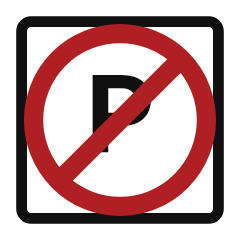
21. A driver leaves the vehicle at the curb where this sign is posted and walks away for two minutes. Is that allowed?
Show answer
Answer B: No, leaving the vehicle unattended there is prohibited whatever the length of the absence
Walking away leaves the vehicle parked, and the prohibition holds regardless of how long the driver is gone or whether the engine is left running.
-
22. When should headlights be switched on besides during the hours of darkness?
Show answer
Answer C: Whenever rain, fog, snow or dust makes it harder to see or to be seen
Headlights are as much about being seen as about seeing, so they go on whenever visibility drops.
-
23. Where is a strong crosswind most likely to hit you suddenly?
Show answer
Answer D: Coming out of a tunnel or a cut onto an open bridge
Gusts arrive the moment you leave shelter, which is why bridge approaches and the ends of cuts and tunnels catch drivers out.
-
24. What does the T-CLOCS pre-ride inspection routine cover?
Show answer
Answer B: Tires and wheels, controls, lights, fluids, chassis and stands
T-CLOCS is a memory aid for a walk around check of tires and wheels, controls, lights and electrics, oil and other fluids, chassis, and side and center stands.
-
25. About how far does a vehicle travel in one second at 60 mph?
Show answer
Answer A: About 88 feet
At 60 mph you cover about 88 feet every second, which is why a glance of only two or three seconds means driving the length of several vehicles blind.
-
26. You are clear of the tracks after your vehicle stalled on a crossing. Whom should you contact?
Show answer
Answer C: The emergency number posted on the blue sign at the crossing, or 911
Grade crossings carry an emergency notification sign with a railroad phone number and a crossing identification number so that approaching trains can be stopped, and 911 works if that sign is not visible.
-
27. You are approaching a blind right hand curve. Which starting lane position gives the best view through it?
Show answer
Answer C: The left portion of the lane, toward the outside of the curve
Starting at the outside of a curve opens up the line of sight through it, and the rider then moves toward the inside as the exit comes into view.
-
28. An orange sign showing the symbol of a person holding a flag or a sign paddle means that
Show answer
Answer D: a person is controlling traffic ahead and the driver must obey that person
The flagger sign warns that a trained flagger is directing traffic further on, and the flagger's instructions govern movement through the work zone.
-
29. You are traveling beside a tractor-trailer and cannot see the truck driver's face in any of the truck's mirrors. What does that tell you?
Show answer
Answer A: The truck driver probably cannot see your vehicle
Large trucks have deep blind spots on all four sides, so if the driver's face is not visible in a mirror the driver has no view of you. Move ahead or drop back until you are out of that area.
-
30. You are about to change lanes to the left when you notice a vehicle already overtaking you in that lane. What should you do?
Show answer
Answer A: Hold your lane and your speed, and change only after that vehicle has gone by
A signal asks for space but does not create it, and the overtaking driver has nowhere to go if you move across.
-
31. A yellow sign ahead of an underpass reads LOW CLEARANCE 12 FT 6 IN. What does the figure tell you?
Show answer
Answer B: The greatest height that can pass beneath the structure
The figure is the actual clearance available, so a vehicle taller than that must leave the road and take a marked alternative route.
-
32. What happens if a passenger leans the opposite way to the rider in a curve?
Show answer
Answer B: The motorcycle becomes harder to steer and may run wide in the curve
A passenger leaning against the turn fights the lean angle the rider has set, forcing extra steering effort and pushing the machine toward the outside of the curve.
-
33. You have turned onto a street and see parked cars facing you and headlights coming toward you. What has probably happened?
Show answer
Answer C: You have turned the wrong way onto a one-way street
Vehicles parked facing you and headlights approaching in your lane are the classic signs of driving against the flow on a one-way street.
-
34. How should your speed behave while you move from one lane into the next?
Show answer
Answer C: Keep it steady or adjust it smoothly to match the traffic in the new lane
A lane change works best as a smooth movement at the speed of the lane you are joining, since sudden braking or acceleration surprises the drivers around you.
-
35. You are stopped at a red light ready to turn right when a person pushing a stroller steps into the crosswalk. What should you do?
Show answer
Answer A: Stay stopped until they have crossed your path
A turn on red gives way to every pedestrian in the crosswalk, and someone pushing a stroller has even less room to react.
-
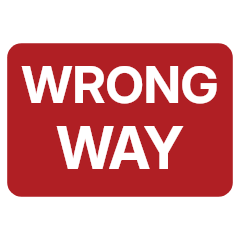
36. At a freeway exit ramp, this sign normally backs up which other regulatory sign posted nearer to the ramp terminal?
Show answer
Answer D: The sign that forbids entering that roadway at all
The two work as a pair at ramp terminals: one keeps drivers from turning in, and this one sits farther along to catch a driver who has already entered.
-
37. A tractor-trailer is backing slowly across the roadway to enter a loading dock. What should you do?
Show answer
Answer C: Stop and wait until the truck has finished the maneuver
A backing truck driver has a very limited view and the trailer can swing unexpectedly. Trying to squeeze past in either direction risks being crushed.
-
38. You arrive at an intersection where the traffic signal is completely dark because of a power failure. How should you proceed?
Show answer
Answer C: Treat the intersection as an all-way stop
When a signal shows no indication at all, drivers on every approach must stop and then take turns, exactly as at an all-way stop.
-
39. What is the danger of releasing the brake too early when moving off uphill?
Show answer
Answer C: The motorcycle rolls backward before the clutch has taken hold
On a grade the brake has to stay on until the engine is actually pulling, otherwise the machine runs back into whatever is behind it.
-
40. Traffic in a work zone is down to one lane in each direction, separated by a temporary double yellow line. May you pass?
Show answer
Answer C: No, temporary markings prohibit passing just as permanent ones do
A temporary marking has the same legal force as a permanent one, and a work zone is the last place with room to spare for an overtaking vehicle.