
Minnesota DVS Motorcycle Practice Test 18
- Questions40
- Correct to pass32
- Passing score80%
- Minimum age16 years
-
1. You have just ridden over a large object lying in the road. What should you do next?
Show answer
Answer A: Pull over when it is safe and check the tires and rims for damage
An impact can cut a tire, dent a rim or bend a fork without giving any immediate change in how the machine feels, so it deserves a look.
-
2. The green left-turn arrow ends and a steady red ball comes on for your lane, at an intersection where no turn on red is allowed. What must you do?
Show answer
Answer D: Stop and wait, because no turn is allowed while the red ball is lit
Once a red indication faces your lane and no turn on red is permitted there, the turn is over; only a vehicle already inside the intersection completes its movement.
-
3. You are approaching a yield sign on a ramp that joins a busy street. What does the sign require?
Show answer
Answer A: Slow down, be ready to stop, and let the other traffic go first
A yield sign means you must slow, be prepared to stop and give way to traffic on the road you are entering; a full stop is required only when traffic makes it necessary.
-
4. On a street with parking along the curb, the shared lane marking is painted well out from the curb face. What does that placement tell a bicyclist?
Show answer
Answer C: To ride clear of the doors of parked cars
The marking is set at least eleven feet from the curb where parking is allowed so that riders are guided outside the reach of an opening door.
-
5. A freeway sign shows a minimum speed limit. What does it require?
Show answer
Answer B: That you keep up with it unless conditions make that unsafe
A minimum speed limit keeps very slow vehicles off the highway, but weather, traffic or a mechanical problem may make a lower speed necessary and lawful.
-
6. An orange sign reading END ROAD WORK is posted beside the highway. What does it mark?
Show answer
Answer C: The point where the work zone restrictions stop
The sign is installed at the downstream end of the temporary traffic control zone to tell drivers that normal conditions apply again.
-
7. A train has just passed a crossing that carries more than one set of tracks. What should you do?
Show answer
Answer B: Wait until the warning devices stop and you can see clearly along every track
A passing train can hide a second one coming on another track, so wait for the signals to clear and check each track before moving.
-
8. You have stopped at a stop line but parked cars hide the cross street. What comes next?
Show answer
Answer C: Edge forward to where you can see, stopping again if needed
The legal stop at the line is only the first stop; you then move up slowly to a point where you can see, and stop again if traffic requires it.
-
9. You have stopped on the shoulder of a busy freeway with a flat tire that you cannot change safely. Where should you and your passengers wait?
Show answer
Answer A: Well away from the traffic side, behind a barrier or up the bank if there is one
People struck on the shoulder are a common cause of roadside deaths, so wait away from the traffic side and behind any barrier.
-
10. A large panel mounted on a trailer at the roadside displays a flashing arrow pointing left. What does it tell you?
Show answer
Answer B: Move into the lane to your left
An arrow panel directs traffic out of a closed lane, so the arrow shows the direction you must move rather than the shape of the road ahead.
-
11. Why do safety agencies put head protection first among riding gear?
Show answer
Answer A: Because head injuries are the leading cause of death in motorcycle crashes
Head injury is the most common cause of death in motorcycle crashes, which is why a certified helmet is the single most important piece of gear.
-
12. You have a green light and are turning right. Pedestrians are stepping off the curb into the crosswalk you are about to cross. What should you do?
Show answer
Answer B: Wait and let them cross before completing your turn
A green light does not release a turning driver from yielding to pedestrians already in the crosswalk of the street being entered.
-
13. What is the job of the hard outer shell of a motorcycle helmet?
Show answer
Answer D: To spread impact force and to resist objects punching through
The shell distributes a concentrated blow over a wide area and stops sharp objects from reaching the head, while the liner underneath absorbs the energy.
-
14. What should a rider understand about the horn on a motorcycle?
Show answer
Answer A: It is often weak and may not be heard, so it never replaces an escape route
A small horn competes with a closed car, a radio and traffic noise, so a rider plans a way out instead of trusting the horn to be heard.
-
15. When should a staggered group change to single file?
Show answer
Answer C: In curves, in turns, and when entering or leaving a highway
Curves, turns and highway entrances and exits require the full width of the lane, so the group rides single file at those points.
-
16. Approaching the point this sign refers to, which hazard is most likely?
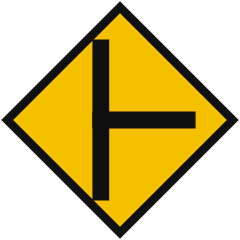
Show answer
Answer A: A vehicle pulling out from the entering road into the driver's path
The main risk is a driver on the entering road who misjudges the gap and pulls out, so covering the brake and being ready to slow is the sensible response.
-
17. What is the driver expected to do after passing this sign?
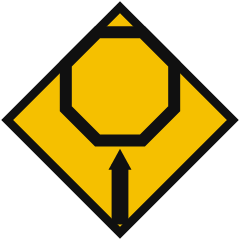
Show answer
Answer A: Begin slowing so that a complete stop can be made at the intersection ahead
It is used where the control at the intersection stays hidden until late, so braking should begin here rather than at the stop line.
-
18. Besides a chemical test, what else supports an impaired driving charge?
Show answer
Answer B: The officer's observations of the driving and the driver
Weaving, slow responses, speech and balance observed by the officer are evidence in their own right, which is why a driver can be charged on behavior alone.
-
19. You have a green left-turn arrow but a pedestrian is still walking in the crosswalk you must cross. What should you do?
Show answer
Answer B: Wait until the crosswalk is clear before turning
A green arrow protects you from other vehicles, but it never removes the duty to yield to a person already in the crosswalk.
-
20. A sign showing a walking figure carries a plaque below it with an arrow slanting down to the right. What does the plaque add?
Show answer
Answer B: The crossing is at that very spot
A downward-slanting arrow plaque marks the crossing itself, whereas an AHEAD or distance plaque would place it further along the road.
-
21. With the chin strap fastened, how can you check that a helmet is the right size?
Show answer
Answer A: Try to roll it forward off your head, since a good fit will not come off
The roll off test shows whether the helmet will stay on in a crash. If it can be rolled off the front of your head with the strap done up, it is too big.
-
22. What is the benefit of looking far down the road rather than just ahead of the hood?
Show answer
Answer A: You steer with smaller corrections and you see trouble in plenty of time
A distant view steadies your steering and gives you time to plan, because you meet hazards after you have already seen them.
-
23. A stalled car sits on a Minnesota shoulder with its hazard warning lights flashing. What must passing drivers do?
Show answer
Answer C: Follow the same move over or slow down duty owed to emergency vehicles
Minnesota Statutes 169.18 extends the move over and slow down duty to a stalled or disabled vehicle that is displaying hazard warning lights.
-
24. What does this sign require of the driver?
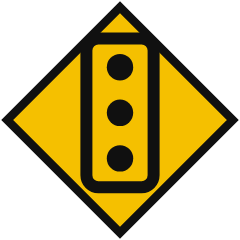
Show answer
Answer D: Reducing speed and being ready to stop at the intersection ahead
The advance notice asks the driver to slow and be ready to stop, while whether a stop is actually needed depends on the indication displayed on arrival.
-
25. A large group has been divided into smaller groups. What should be done between them?
Show answer
Answer A: Leave a gap big enough for other vehicles to move in and pass safely
A gap between sub groups lets other traffic pass or merge without cutting into a formation, which keeps drivers from making sudden moves around the riders.
-
26. Beyond this sign, cones and temporary signs lead traffic along a path that does not agree with the lines painted on the pavement. Which one must the driver follow?
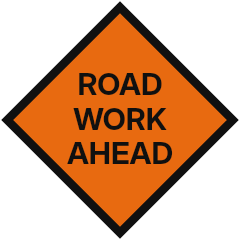
Show answer
Answer C: The temporary arrangement, because it replaces the permanent layout while the work lasts
Temporary traffic control set up for the work takes precedence over the permanent signs and markings, which no longer describe how the road is being used.
-
27. Besides school signing, which warning signs may also use a fluorescent yellow-green background?
Show answer
Answer C: Pedestrian and bicycle warning signs
Pedestrian crossing, bicycle and playground warning signs may use either the standard yellow or the fluorescent yellow-green background, which draws extra attention where people outside vehicles are present.
-
28. Some crosswalks are marked with two transverse lines and others with a row of wide bars laid along the direction of travel. Why is the second pattern used?
Show answer
Answer B: It is far easier for an approaching driver to see
Longitudinal bar patterns are used where extra visibility is wanted, such as an uncontrolled crossing or one near a school, because they show up much better from a car.
-
29. What should a rider remember about convex mirrors?
Show answer
Answer B: They show a wider view, but vehicles look farther away and slower than they are
The curved glass fits more of the scene into the mirror, and the price of that extra width is a distorted sense of distance and closing speed.
-
30. How can a rider check the action of the front suspension while the motorcycle is stationary?
Show answer
Answer D: Hold the front brake on and push down on the bars to feel the forks move and return
Compressing the forks against the front brake shows whether they move smoothly and return without binding, sticking or making noise.
-
31. Does Minnesota's hands-free law apply while a driver waits in a line of traffic at a red light?
Show answer
Answer C: Yes, because the vehicle is a part of traffic
Minnesota Statutes 169.475 applies while a vehicle is in motion or a part of traffic, so a stop at a signal does not lift the restriction.
-
32. This sign is still standing late at night, and nobody is working. What should the driver assume?
Show answer
Answer B: The layout may still be altered, so the same care and reduced speed apply
Narrowed lanes, shifted alignments, dropped pavement edges and parked equipment remain overnight, so the hazard does not end when the crew goes home.
-
33. You are waiting in a left-turn lane at a green light when a fire engine with lights and siren comes toward you in the oncoming lanes. What should you do?
Show answer
Answer D: Hold your position and let the fire engine pass
Turning across the path of an approaching emergency vehicle is exactly what you must not do; stay put until it has gone by.
-
34. How is the yield sign shaped and colored?
Show answer
Answer C: A downward-pointing triangle with a wide red border and a red legend on white
The yield sign is a downward-pointing equilateral triangle with a wide red border and the legend in red on a white background, an outline used for no other message.
-
35. You have begun to move into the next lane when the gap you were aiming for closes. What is the safest action?
Show answer
Answer C: Return to your own lane, cancel the signal and wait for a better gap
An unfinished lane change leaves you in a space that no longer exists, and the lane you came from is still yours.
-
36. A turn restriction sign at the corner shows a range of times below the symbol. What does that mean?
Show answer
Answer A: The turn is banned only during the hours shown on the sign
Times posted under a regulatory symbol set the period during which the restriction applies; outside those hours the movement is permitted.
-
37. Below a speed limit sign is a smaller panel with white numbers on a black background and the word NIGHT. What does it show?
Show answer
Answer D: The limit that applies after dark
A night speed limit panel sets a separate legal maximum for the hours of darkness, and its reversed colors mark it as the night figure.
-
38. You are the first driver on a road just after a storm. What should you plan for?
Show answer
Answer B: Branches, mud and other debris hidden around the next bend
Storm debris lands where nobody has cleared it yet, often just beyond a curve or a crest, so reduce speed and look much further ahead.
-
39. What do white lane lines painted between travel lanes indicate?
Show answer
Answer A: Traffic in the adjacent lane moves in the same direction as you
White markings separate lanes carrying traffic in the same direction and mark the right edge of the roadway.
-
40. What causes the side to side motion a rider feels when crossing a steel grid deck or rain grooves?
Show answer
Answer C: The tires following the ridges and grooves, which is normal and harmless
The tread follows the pattern in the surface, which produces a wandering feel. The motorcycle is not out of control, so relax on the bars and hold your speed.