
Minnesota DVS Motorcycle Practice Test 22
- Questions40
- Correct to pass32
- Passing score80%
- Minimum age16 years
-
1. What is the basic rule for entering a roundabout?
Show answer
Answer B: Traffic already circulating goes first, and you wait for a gap
Entering traffic yields to vehicles already going around the circle, which is what keeps a roundabout moving instead of locking up.
-
2. Your vehicle stalls on railroad tracks and you see a train approaching. What should you do?
Show answer
Answer D: Get everyone out and run toward the train at an angle away from the tracks
Leave the vehicle at once. Running toward the oncoming train and away from the tracks keeps you clear of the wreckage, which is thrown forward in the direction the train is moving.
-
3. You are traveling a long distance on a highway with three lanes in your direction, at about the speed of the surrounding traffic. Which lane is generally the best choice?
Show answer
Answer C: The center lane, which keeps you clear of merging traffic and of overtaking traffic
On a three-lane roadway the center lane avoids both the ramp traffic on the right and the overtaking traffic on the left, so it usually has the steadiest flow.
-
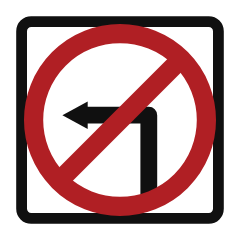
4. A driver in the leftmost lane reaches this sign at an intersection. What must the driver do?
Show answer
Answer B: Go straight on or turn right, and reach the destination another way
The restriction holds whatever the traffic or the signal is doing, so the driver has to pass the intersection and plan a different route.
-
5. You are stopped at a stop sign waiting to turn onto a highway where traffic moves at 55 mph. How should you choose your gap?
Show answer
Answer A: Wait for a much larger gap than the one you would accept on a city street
Fast traffic covers ground while you are still accelerating, so the gap that feels adequate at 25 mph is dangerously short at highway speed.
-
6. You are approaching a sharp curve. When should you reduce your speed?
Show answer
Answer D: Before you enter the curve, so you can accelerate gently through it
Braking hard inside a curve uses up the traction that is already being demanded for cornering, so the slowing must be finished before you enter.
-
7. Your exit from a three-lane highway is about a mile ahead on the right, and you are in the left lane. What should you do?
Show answer
Answer B: Start moving right now, one lane at a time
Plan ahead and change lanes one at a time well before the exit, so you never have to cut across several lanes at the gore.
-
8. In a work zone a flagger signals you to stop, but the sign beside the road says the lane is open. What should you do?
Show answer
Answer C: Obey the flagger
A flagger controls the work zone in real time and the instruction outranks the signs and markings, which cannot reflect what is happening at that moment.
-
9. A funeral procession with headlights on is crossing an intersection when your light turns green. What should you do?
Show answer
Answer A: Wait and let the whole procession go through
Most states let a funeral procession stay together once the lead vehicle has lawfully entered an intersection, and in every state you must yield to vehicles already in the intersection, so wait until the line has passed.
-
10. Your vehicle is burning at the roadside. How far away should everyone keep?
Show answer
Answer D: At least a hundred feet away from the vehicle and upwind, out of the drifting smoke
Burning vehicles give off toxic smoke and parts such as tires and struts can burst, so keep a long distance and stay upwind.
-
11. You are joining a highway from a short ramp that has no acceleration lane. What should you do?
Show answer
Answer A: Stop or slow at the end of the ramp and wait for a safe gap
Without an acceleration lane there is no room to match speed, so you must yield at the end of the ramp and enter only when a gap allows it.
-
12. A black on white regulatory sign at an intersection reads NO TURNS. What may a driver do there?
Show answer
Answer B: Only continue straight through the intersection
The NO TURNS sign bans turns in every direction at that intersection, so the only lawful movement from that approach is straight through.
-
13. Cannabis is legal for adults in some states. What does that mean for driving?
Show answer
Answer C: Driving while impaired by it is still an offense
Legal possession has nothing to do with driving law, and every state treats driving while impaired by cannabis as an offense.
-
14. Which warning sign keeps its yellow background even when it is used inside a work zone?
Show answer
Answer D: The grade crossing advance warning sign
The round grade crossing advance warning sign keeps its black legend on yellow inside temporary traffic control zones because the railroad hazard it describes is not temporary.
-
15. A broken white line separates your lane from the lane on your right. What does it permit?
Show answer
Answer C: Changing lanes when it is safe to do so
A normal broken white line marks a boundary between lanes traveling the same way that road users may cross when it is safe.
-
16. You are riding along a street lined with parked cars. What is the safest approach?
Show answer
Answer D: Move away from the parked cars, slow down, and watch for doors and people
Doors open, drivers pull out and pedestrians step between vehicles, so extra space and a lower speed give the rider time to see and react.
-
17. An overhead lane-use control signal shows a steady red X above the lane you are traveling in. What does it require?
Show answer
Answer D: Leave that lane, because it is closed to you
A steady red X means road users are not permitted to use the lane beneath it, so you must move into a lane that is open.
-
18. You come upon a crash that has just happened and decide to help. Where should you stop your vehicle?
Show answer
Answer A: Well beyond the scene, completely off the road, with the hazard lights on
Stopping past the crash and off the pavement keeps you from becoming another victim and leaves the approach clear for emergency vehicles.
-
19. What is the purpose of carrying a first aid kit in your vehicle?
Show answer
Answer D: It lets you treat cuts and bleeding while the help is on its way
A kit is for simple first aid such as controlling bleeding until trained help arrives, not a substitute for calling for that help.
-
20. Two left-turn lanes are available and you must turn right again a short distance after the turn. Which of the two should you use?
Show answer
Answer D: The right one, so you finish nearer the right side of the new street
Each turn lane feeds the matching lane of the new street, so choosing the right-hand of the two left-turn lanes leaves you closer to the side you will need.
-
21. A motorcycle in your group develops a mechanical problem on a busy highway. What is the best response?
Show answer
Answer C: Signal the group off at the next exit or wide, safe pull off area
A narrow shoulder beside fast traffic is a dangerous place to gather, so the group moves on to a spot where every machine is well clear of the roadway.
-
22. You have turned onto a ramp at night and your headlights pick out large white arrows painted on the pavement pointing straight back at you. What do they mean?
Show answer
Answer C: You are traveling against the flow and must turn back
Wrong-way arrows are laid so that a driver going the correct way never sees them head on, so an arrow pointing at you means you are on the ramp backwards.
-
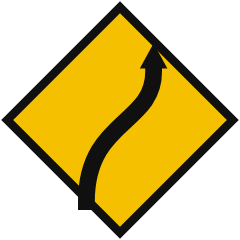
23. What does this sign tell a driver about the road ahead?
Show answer
Answer A: The roadway changes direction ahead, so speed should be reduced before reaching it
It gives advance notice of a change in alignment so the driver can slow down before entering, since braking inside a bend uses up grip that is needed for steering.
-
24. A deer crosses the road in front of you and disappears into the trees. What should you expect?
Show answer
Answer B: That other deer are likely to follow it across the very same stretch of road
Deer usually move in groups, so one crossing the road is a warning that more may follow.
-
25. Why should a rider pull in the clutch at the first sign that the engine is seizing?
Show answer
Answer B: So a locking engine cannot lock the rear wheel through the drive train
A seizing engine can lock up, and with the clutch engaged that would lock the rear wheel, so disconnecting the drive keeps the wheel rolling while you coast off the road.
-
26. Blue pavement markings are used together with white markings at
Show answer
Answer D: parking spaces reserved for people with disabilities
Blue supplements the white markings of accessible parking spaces, which is the only assignment blue has on the pavement.
-
27. A mixed drink is made with two shots of spirits. How much alcohol is that?
Show answer
Answer C: About two standard drinks
A standard drink is a fixed amount of pure alcohol, so a glass poured with two measures counts as two drinks however it is served.
-
28. A driver holds a steady highway speed into the section this sign warns about. What is the most likely result?
Show answer
Answer B: The vehicle runs wide toward the outside and can cross into another lane or leave the pavement
Holding speed into a change of alignment asks the tires for more side grip than they can supply, so the vehicle runs wide and the driver is left with less room to correct.
-
29. A black and white regulatory sign facing traffic at a divided section reads KEEP LEFT. What does it require?
Show answer
Answer D: Passing the island or obstruction on its left side
Keep Left is posted at an island or obstruction that traffic must pass on the left, which is the opposite of the far more common Keep Right situation.
-
30. Why does a motorcycle with a manual fuel supply valve have an OFF position?
Show answer
Answer A: It stops fuel reaching the engine while the machine is parked
Shutting the valve keeps fuel from seeping past the carburetor into the engine or onto the ground while the motorcycle stands unused.
-
31. Traffic is backed up beyond a railroad crossing. When may you start across the tracks?
Show answer
Answer B: Only when there is room for your whole vehicle on the far side
Never enter a crossing you cannot clear; a vehicle stopped on the tracks in a queue has nowhere to go if the signals start.
-
32. What matters most about the armor built into a riding jacket?
Show answer
Answer B: That it sits over the joints and stays there during a fall
Armor only works where it is, so the jacket must fit closely enough that the pads stay over the shoulders, elbows and spine when the rider hits the ground.
-
33. After the leader of a staggered group completes a pass, what should the leader do?
Show answer
Answer A: Move to the left position and hold passing speed to open room for the next rider
Returning to the left position and keeping speed opens the gap the next rider needs to finish the pass and settle back into formation.
-
34. When are you expected to switch from high beams to low beams?
Show answer
Answer D: When a vehicle approaches from ahead or you come up behind another vehicle
High beams blind other drivers, both those coming toward you and those you follow through their mirrors. Dim them whenever another vehicle is within range.
-
35. You are wearing a high visibility jacket. How should that change the way you ride?
Show answer
Answer B: You still ride as though drivers have not seen you
Bright gear improves your odds of being noticed but guarantees nothing, so keep the lane position, space cushion and escape routes that protect you anyway.
-
36. You have passed a large truck and want to move back into its lane. What should you see first?
Show answer
Answer B: Both of its headlights in your rear-view mirror
Seeing both headlights in your mirror means you are far enough ahead to be out of the truck's front no-zone before you move over.
-
37. You have just been involved in a crash on a city street. Which sequence of first steps is correct?
Show answer
Answer A: Stop where you are, check everyone for injuries, and then make the scene safe
You are required to stop, and the first priority at the scene is people, followed by preventing a second collision.
-
38. On a rainy road, where can a rider usually find the best traction?
Show answer
Answer A: In the tire tracks left by the vehicles ahead
Vehicles ahead push water aside and keep their tracks clearer of oil, so those tracks generally give better grip than the rest of the lane.
-
39. Enhanced reference location markers differ from ordinary mileposts in that they
Show answer
Answer B: carry the route number and a mileage figure to the tenth of a mile
An enhanced reference location marker adds the route designation and carries the mileage to a tenth, so the point named is far more precise than a plain milepost.
-
40. You reach an intersection showing a steady red light, and a stop line is painted across your lane. Where must you bring the vehicle to a complete stop?
Show answer
Answer C: Before the stop line
A steady red requires a complete stop before the marked stop line. Where there is no stop line you stop before the crosswalk, and where there is neither, before entering the intersection.