
Minnesota DVS Motorcycle Practice Test 24
- Questions40
- Correct to pass32
- Passing score80%
- Minimum age16 years
-
1. A pedestrian starts to cross against a Do Not Walk signal, right in front of you. What should you do?
Show answer
Answer D: Slow or stop and let the person reach safety
Even when a pedestrian is crossing unlawfully, a driver must take reasonable care to avoid hitting that person.
-
2. A small signal face beside a bikeway shows red, yellow and green lenses that each carry a bicycle symbol. Whom does it control?
Show answer
Answer C: Bicyclists using that crossing or bikeway
A bicycle signal face governs bicycle movements only, and people on foot at the same corner still follow the pedestrian signal.
-
3. A square sign with a red field, a wide white horizontal bar and the words DO NOT ENTER tells a driver that
Show answer
Answer B: the roadway ahead must not be entered from that point
The do not enter sign is posted at the end of a one-way roadway or ramp to keep traffic from driving into it against the flow.
-
4. About how far ahead do low beam headlights let you see on a dark road?
Show answer
Answer B: About 250 feet
Low beams light roughly 250 feet of road, and high beams roughly 350 to 500 feet, which sets the limit on a safe night speed.
-
5. Why is standing water across a road dangerous even when it looks shallow?
Show answer
Answer B: It can hide a washed out roadbed, a deep hole or a missing cover
You cannot see the surface under the water, and floods commonly wash the roadbed away or lift covers off drains.
-
6. What do the grooves in a tire tread do on a flooded road surface?
Show answer
Answer B: They give the water a way to escape so the tread can touch the road
Tread grooves pump water out from under the tire so rubber can meet pavement. A worn tread moves less water, so hydroplaning starts sooner.
-
7. Where in the United States may a motorcycle ride between lanes of traffic?
Show answer
Answer C: Only where a state has specifically authorized it
Riding between lanes is prohibited in most states and permitted only where a state law expressly allows it, so a rider must know the rule for the state being ridden in.
-
8. Besides the traffic behind you, what else must you check before moving into the next lane?
Show answer
Answer D: That there is room ahead in the new lane for your normal following distance
Moving into a gap that is too short leaves you tailgating the vehicle ahead with a vehicle close behind you.
-
9. What should a rider check about the size of a motorcycle before riding it?
Show answer
Answer C: That both feet reach the ground and the controls are within reach
A motorcycle that fits lets the rider put both feet down at a stop and work every control without stretching, and a machine that is too tall or too heavy is hard to hold up in slow traffic.
-
10. Compared with dry pavement, how much room does a vehicle need to stop on packed snow?
Show answer
Answer D: Several times as much
Grip on packed snow is a fraction of that on dry pavement, so stopping distance grows several times over. Antilock brakes help you steer, not stop shorter.
-
11. What is the usual result of driving well above the flow of traffic on a typical trip?
Show answer
Answer B: Very little time saved, with much greater risk
Signals, traffic and short distances swallow the theoretical gain, while crash risk and crash severity both climb sharply with speed.
-
12. You are involved in a collision, even a minor one. What is your first legal duty?
Show answer
Answer A: Stop at or near the scene without blocking traffic more than necessary
Every driver involved in a crash must stop at the scene, and leaving before meeting that duty is a serious offense. Move the vehicles only as far as needed to clear the traffic lanes.
-
13. Why should riding gloves fit snugly?
Show answer
Answer C: So loose material does not dull your feel for the controls
Bunched or baggy material gets between your hand and the grip, so a close fitting glove keeps the feel for the throttle, clutch and brake lever.
-
14. What is wrong with slowing to a crawl at a stop sign and then rolling on through?
Show answer
Answer C: It is not a stop, and you may miss a pedestrian or cross traffic
A rolling stop is a violation and it also cuts short the moment you need in order to look carefully in each direction before entering.
-
15. You want to turn left at an intersection with no signs or signals and a vehicle is coming straight toward you from the opposite direction. What must you do?
Show answer
Answer C: Yield and turn after the oncoming vehicle has passed
A driver turning left always gives way to oncoming traffic that is close enough to be a hazard, whether or not the intersection is controlled.
-
16. You have a green arrow to turn left. What still applies?
Show answer
Answer D: You must yield to any pedestrian or vehicle still inside the intersection
A green arrow protects your turn from conflicting traffic, but you must still let anyone already in the intersection get clear before you move.
-
17. What speed limit may a Minnesota road authority adopt for a residential roadway?
Show answer
Answer C: 25 mph
Minnesota Statutes 169.14 lets a road authority adopt a 25 mile per hour limit on residential roadways.
-
18. At what alcohol concentration can a Minnesota driver be arrested for driving while impaired even without other evidence?
Show answer
Answer C: 0.08 percent
A person in control of a moving or parked vehicle with an alcohol concentration of 0.08 percent or higher can be arrested for driving while impaired, and the commercial vehicle threshold is 0.04 percent.
-
19. What happens when alcohol is combined with another drug that also affects the nervous system?
Show answer
Answer B: Impairment is often far greater than either one alone would produce
Combined substances can multiply each other's effects, producing impairment well beyond what a driver would expect from either one taken separately.
-
20. What does it mean to ride the clutch?
Show answer
Answer C: Holding the lever part way in while riding, which wears the clutch plates
Cruising with the clutch partly disengaged makes the plates slip against each other, which wears them out and removes engine braking.
-
21. Which restrictions apply while riding on a Minnesota motorcycle instruction permit?
Show answer
Answer B: No passengers and no riding at night, plus a DOT helmet and eye protection
A Minnesota permit rider must wear a DOT-approved helmet and eye protection, may not carry passengers and may not ride at night, defined as half an hour after sunset to half an hour before sunrise.
-
22. Why should a load never be fastened to the handlebars or the front forks?
Show answer
Answer D: The weight upsets the steering and makes the front end handle unpredictably
Anything hung on the steering moves with it and changes how the motorcycle turns, which is why loads belong low and behind the rider instead.
-
23. Which color scheme is standard for the drums and barricades that channel traffic through a work zone?
Show answer
Answer C: Alternating orange and white retroreflective stripes
Drums and barricades carry alternating orange and white retroreflective stripes, and the traffic cones used in the same zones are predominantly orange.
-
24. Why must a rider pay attention to the turn signal after completing a turn or lane change?
Show answer
Answer A: Many motorcycle signals do not cancel themselves and can mislead other drivers
A signal left flashing tells other drivers the rider is about to turn again, and a driver may pull out in front of the motorcycle because of it.
-
25. Your vehicle stalls on a railroad crossing and will not restart. What should you do first?
Show answer
Answer A: Get everyone out and away from the tracks immediately
Everyone must leave the vehicle and move well clear of the tracks at once, walking toward the train at an angle so that debris from an impact travels away from you.
-
26. You brake hard on a wet road and need to steer around a stalled car. How do antilock brakes help you do that?
Show answer
Answer B: They stop the wheels locking, so the tires can still turn the vehicle
Locked wheels slide and cannot change direction. By preventing lockup the system lets you brake at full force and steer at the same time.
-
27. You are on an entrance ramp merging onto a freeway. Who has to give way?
Show answer
Answer B: You must yield and fit into a gap in the traffic already on the freeway
Traffic entering a highway must yield to traffic already on it. Use the acceleration lane to match speed and merge into a gap.
-
28. Why should the leader of a group signal turns and lane changes early?
Show answer
Answer D: So the message has time to reach the riders at the back of the group
An early signal gives the whole formation, including the riders far back in the line, time to see the change and prepare for it.
-
29. You are turning left from a one-way street onto another one-way street. Which lane should you use?
Show answer
Answer B: Turn from the far left lane into the far left lane of the new street
The general turning rule is to turn from the lane nearest the direction of the turn into the nearest lane of the new roadway, which on a one-way to one-way left turn means far left to far left.
-
30. Which of the four blind spots around a tractor-trailer is the largest?
Show answer
Answer A: The one on the right side of the truck
A truck has no-zones on all four sides, and the right-side blind spot is the largest because it runs back along the trailer and reaches across more than one lane.
-
31. With the engine off, a rider turns the handlebars fully to the left and to the right. What is being checked?
Show answer
Answer A: That the steering moves freely and no cable is pinched or binding
Cables and wiring that catch at full lock can hold the throttle open or stiffen the steering exactly when the rider needs a tight turn.
-
32. Within what range may a Minnesota local authority set a school speed limit?
Show answer
Answer A: 15 to 30 mph
Minnesota Statutes 169.14 lets local authorities establish school speed limits of between 15 and 30 miles per hour in a school zone.
-
33. What kind of sole and heel suit motorcycle boots?
Show answer
Answer A: A hard, slip resistant sole with a low heel that will not catch
Boots have to grip the pavement when you put a foot down and grip the footrests while you ride, and a tall heel can catch on the ground or on the machine.
-
34. What is the correct way to apply the front brake when you need maximum braking?
Show answer
Answer C: Squeeze it progressively harder as weight settles onto the front tire
Progressive pressure lets load build on the front tire before the braking force does, so the tire has the grip needed to handle it.
-
35. When should you move into the lane you need for a turn?
Show answer
Answer D: Well before the intersection, as soon as you know your route
Getting into the correct lane early lets other drivers read your intentions and keeps you from making a sudden lane change at the corner.
-
36. Which surfaces usually offer less grip than the pavement around them when wet?
Show answer
Answer B: Painted markings, metal plates and bridge decks
Paint, steel and bridge decks all shed grip when wet or cold, so brake before you reach them rather than on top of them.
-
37. Apart from other vehicles, who else must a driver let go first at this sign?
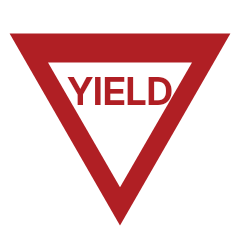
Show answer
Answer A: Pedestrians and cyclists already in or entering the crossing
The duty to give way covers every road user who has the right of way at that point, including people walking or cycling across the driver's path.
-
38. A traffic light ahead of the group turns yellow as the leader approaches it. What should the leader do?
Show answer
Answer C: Stop normally and let the group be split by the signal
Keeping the group together never outranks obeying the signal, and the riders left behind simply catch up at the next stop.
-
39. Four vehicles reach a four-way stop from all four directions at the same instant. How is the deadlock resolved?
Show answer
Answer C: Each driver yields to the vehicle on the right and they go one by one
Yielding to the right applies to every driver, so the group untangles itself as drivers take turns rather than moving together.
-
40. What is wrong with riding in sneakers or sandals?
Show answer
Answer D: They come off, expose the foot and give no protection in a fall
Light footwear tears away or comes off in a crash and offers no abrasion or crush protection for the foot and ankle.