
Minnesota DVS Motorcycle Practice Test 27
- Questions40
- Correct to pass32
- Passing score80%
- Minimum age16 years
-
1. You are moving at walking pace through a crowded parking area. Which combination gives the steadiest control?
Show answer
Answer B: Steady throttle, the clutch held in the friction zone and light rear brake
Slipping the clutch in the friction zone against a steady throttle and a light drag of rear brake keeps power smooth and the machine stable below walking speed.
-
2. The vehicle you want to pass is traveling close to the speed limit. What should you do?
Show answer
Answer C: Stay behind, because a pass may not take you over the limit
The speed limit applies while passing too. If you cannot complete the pass without exceeding it, do not start the pass.
-
3. A yellow sign reads SOFT SHOULDER. What is it telling you?
Show answer
Answer C: The shoulder may not carry the weight of a vehicle
A soft shoulder is unpaved and can let a wheel sink, so a driver who leaves the pavement there may lose control or become stuck.
-
4. Why should gloves and jacket sleeves overlap?
Show answer
Answer A: So no gap of bare skin is left at the wrist in a slide or the cold
The wrist is easy to leave exposed, and a gap there lets in cold air and takes the full force of a slide, so gauntlets or elastic cuffs should close the gap.
-
5. The sun is low behind you and shining into the eyes of oncoming drivers. What should you do?
Show answer
Answer C: Turn on your headlights and expect oncoming drivers not to see you
Drivers facing the low sun may not see you at all, so make yourself as visible as possible and give way rather than insisting on your right of way.
-
6. Why does a motorcycle feel less stable at very low speed when a passenger is aboard?
Show answer
Answer B: The passenger's weight sits high and to the rear, so balance is easier to upset
A second person adds mass above and behind the rear axle, so slow speed maneuvers such as pulling away, walking pace turns and stops demand more care.
-
7. You feel drowsy, so you open a window and turn the radio up. What does that achieve?
Show answer
Answer B: Very little, because the drowsiness comes back
Cold air and loud music are not sleep, so the alerting effect lasts a minute or two and the driver is soon just as sleepy and closer to a lapse.
-
8. You are in the open lane where another lane is merging into yours. What is your part in the merge?
Show answer
Answer A: Keep a steady speed and leave a gap for one vehicle to come in
A merge works when each driver in the through lane lets one vehicle in, which keeps both lines moving instead of stopping them both.
-
9. Permanent signs must be retroreflective or lighted so that
Show answer
Answer A: they show the same shape and color at night as by day
Retroreflective sheeting throws headlight light back to the driver, so a sign keeps its daytime shape and color after dark.
-
10. How should a rider adjust speed on an unlit road at night?
Show answer
Answer C: Slow enough to stop within the distance the headlight actually lights up
A rider can only react to what is visible, so night speed has to fit the distance the headlight reaches rather than the posted limit.
-
11. You are parked legally, but a police officer tells you to move the vehicle. What should you do?
Show answer
Answer B: Move it as directed, because an officer overrides the signs
Directions from a police officer or a firefighter take precedence over signs and markings, whether they are directing traffic or clearing a street.
-
12. What is the consequence of refusing a chemical test under the Minnesota implied consent law?
Show answer
Answer D: A crime and a revocation of driving privileges of one to six years
Refusing the blood, breath or urine test is a crime in Minnesota and results in a revocation of one to six years depending on the number of prior offenses.
-
13. A driver is following your motorcycle much too closely. What should you do?
Show answer
Answer B: Ease off the throttle and open more space ahead so the driver can pass
Slowing gradually and opening a bigger gap in front encourages the tailgater to pass and gives the rider room to stop gently instead of hard.
-
14. Why should you stay out of an intersection you cannot clear, even on a green light?
Show answer
Answer B: Because you would block cross traffic when their signal turns green
A vehicle stranded in the intersection blocks the cross street when its light turns green, which stalls the whole junction and traps emergency vehicles.
-
15. Apart from a crash, when do helmet makers generally advise replacing a helmet?
Show answer
Answer A: After several years of use, as the liner and materials age
Liners, glues and straps degrade with sweat, sunlight and time, so manufacturers commonly recommend replacing a helmet after several years even if it looks fine.
-
16. You are about to accelerate hard to merge with traffic. What should you have arranged with your passenger?
Show answer
Answer D: That you warn them beforehand so they can tighten their grip
A passenger who is not expecting a burst of acceleration is thrown backward, and the sudden shift of weight upsets the machine just when the rider needs it settled.
-
17. You must slow suddenly on a highway and a vehicle is following close behind you. What helps prevent a rear-end collision?
Show answer
Answer D: Tapping the brake pedal early so your brake lights flash a warning
Early brake light flashes give the driver behind more time to react, and slowing gradually instead of suddenly reduces the chance of being struck.
-
18. You reach a stretch of road covered by moving flood water of unknown depth. What is the correct decision?
Show answer
Answer D: Turn around and take another route
About a foot of moving water is enough to carry away most cars, and the roadbed under the water may already be washed out, so the only safe choice is to turn around.
-
19. A strong wind is blowing steadily across the road from your left. How should you ride?
Show answer
Answer A: Move toward the left of the lane and lean into the wind
Riding on the windward side of the lane leaves room to be pushed without leaving the lane, and a slight lean into the wind holds the line.
-
20. How can you check that you are keeping a safe following distance?
Show answer
Answer A: Count at least three seconds between the vehicle ahead passing a fixed object and your reaching it
Pick a fixed roadside object, start counting when the vehicle ahead passes it and make sure at least three seconds elapse before you reach it, adding more time in poor conditions.
-
21. You are waiting to turn left and an oncoming vehicle stopped in the near lane to turn left blocks your view of the far lane. What should you do?
Show answer
Answer A: Wait where you are until you can see that the far lane is completely clear
The lane you cannot see is where the crash comes from, so you hold your position until the view opens up.
-
22. The car ahead drifts across the lane line and back again several times. What should you do?
Show answer
Answer C: Assume that the driver is distracted or impaired, and keep well back
Drifting is a classic sign of a distracted, drowsy or impaired driver, and distance is your protection from all three.
-
23. A high-occupancy vehicle lane is separated from the general lanes by a pair of solid white lines with a gap every so often. Where may you enter or leave it?
Show answer
Answer D: Only at the openings where the solid lines are broken
The solid lines forbid crossing, so entry and exit are limited to the designated openings where the marking is broken.
-
24. The lane you are in has a right-turn-only arrow painted on the pavement. What must you do?
Show answer
Answer C: Turn right, because a lane-use arrow is a legal requirement
Lane-use arrows painted on the pavement are regulatory markings, so a driver in that lane must travel in the direction shown.
-
25. Where should the least experienced riders be placed in a group?
Show answer
Answer C: Just behind the leader
Placing newer riders just behind the leader keeps the pace manageable for them and lets the more experienced riders behind keep an eye on them.
-
26. You make eye contact with a driver waiting to pull out of a side street. What should you assume?
Show answer
Answer D: The driver may still not have seen you, so stay ready to slow or stop
Drivers can look directly at you and still not register your vehicle, especially a small one. Eye contact helps, but never rely on it.
-
27. A yellow diamond in which one line joins another at an angle warns that
Show answer
Answer B: traffic from another roadway will merge into the driver's lane ahead
The merge sign warns that another traffic stream will join the same lane ahead, so drivers on both roadways must adjust speed and spacing.
-
28. Does this sign settle who has the right-of-way at the intersection ahead?
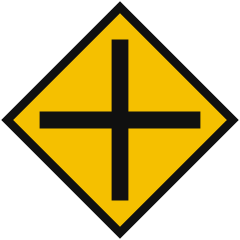
Show answer
Answer D: No, it only gives notice of the intersection; the control there decides priority
A warning prepares the driver for what is coming but grants no priority, so whatever stop control, yield control, signal or right-of-way rule applies at the intersection is what decides.
-
29. Two solid white lines separate your lane from the lane beside it. What do they mean?
Show answer
Answer B: Crossing from one lane to the other is prohibited
A solid double white line marks a boundary that road users may not cross, such as the entrance to a preferential lane.
-
30. May you park at the curb immediately next to a railroad crossing?
Show answer
Answer A: No, you must leave the crossing and its approach clear
Parking beside a crossing hides the tracks and the signals from approaching drivers and leaves no room for a vehicle that has to clear the rails.
-
31. How much should you normally reduce your speed on a road covered with packed snow compared with dry conditions?
Show answer
Answer C: By about half
Packed snow roughly doubles the distance needed to stop, so a common guideline is to cut speed by about half. On ice, slow to a crawl.
-
32. Why is it harder for a rider to judge distance and closing speed after dark?
Show answer
Answer D: Only lights are visible, so closing speeds are hard to read
At night you see lights rather than whole vehicles and the scene around them, which strips away the cues that tell you how far away something is and how fast it is closing.
-
33. Why is it worth planning your route before a long drive?
Show answer
Answer B: So that you are not reading a map or a screen while the car is moving
A driver who knows the route is not navigating at the wheel, which is one of the commonest sources of distraction.
-
34. You are descending a long steep grade with a loaded truck close behind you. What should you do?
Show answer
Answer A: Hold a steady speed and let it pass when it can
Gravity pushes a loaded truck downhill and it cannot slow quickly, so give it a predictable speed and room to get by rather than braking in front of it.
-
35. Where should a rider in the middle of a group direct their attention?
Show answer
Answer A: Well ahead through the group and around it, not just at the rider in front
Watching only the machine ahead hides the traffic and hazards further up the road, and it leaves the rider reacting late to everything the group meets.
-
36. A yellow pennant, an isosceles triangle with its long axis horizontal, is reserved for which message?
Show answer
Answer D: No passing zone
The pennant shape is used only for the no passing zone sign, which marks the point where overtaking is no longer allowed.
-
37. You arrive at a four-way stop after two other vehicles have already stopped there. When is it your turn?
Show answer
Answer A: After both of the earlier vehicles have gone
Vehicles clear a four-way stop in the order they arrived, so the third driver to stop is the third to go.
-
38. In a staggered formation, where does the second rider belong?
Show answer
Answer C: In the right portion of the lane, about one second behind the leader
The second rider uses the opposite side of the lane roughly one second behind the leader, which staggers the group without stretching it out or putting the two riders alongside each other.
-
39. Two vehicles meet on a steep, narrow mountain road with no room to pass. Which driver should back up?
Show answer
Answer C: The driver heading downhill, who has more control while reversing
On a narrow mountain road the vehicle facing downhill yields, because backing uphill gives better control than reversing down a grade.
-
40. Is it acceptable to leave your vehicle across the entrance of an alley for a short time?
Show answer
Answer A: No, the entrance must stay clear at all times
Blocking an alley entrance traps the vehicles inside and can keep emergency services out, so it is prohibited however brief the stop.