
Minnesota DVS Motorcycle Practice Test 32
- Questions40
- Correct to pass32
- Passing score80%
- Minimum age16 years
-
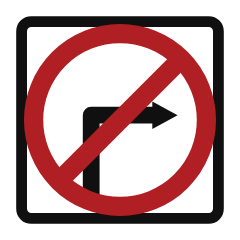
1. A driver stopped at a red signal wants to turn right and this sign is posted at the corner. What is permitted?
Show answer
Answer A: Nothing: the turn is barred whether the signal is red or green
The restriction works independently of the signal, so the usual permission to turn right after stopping at a red light does not exist where this sign is posted.
-
2. You are approaching a horse and rider on a country road. What about your horn?
Show answer
Answer C: Do not sound it at all, because the noise can frighten the animal
A startled horse is dangerous to its rider and to you, so pass wide and slow and leave the horn alone.
-
3. A separate right-turn lane leads onto the cross street and carries a yield sign. What does it require?
Show answer
Answer D: Slowing and giving way to traffic and people, stopping if needed
A yield requires you to slow, give way to traffic in the lane you are joining and to pedestrians, and stop only if that is what safety demands.
-
4. Which clue tells you that a parked vehicle is about to pull into traffic?
Show answer
Answer D: Exhaust smoke, brake lights, front wheels turned out or a driver in the seat
A running engine, lit brake lights, turned wheels or a person behind the wheel all mean the vehicle may move. Slow down and give it room.
-
5. How does being tired change your total stopping distance?
Show answer
Answer A: It lengthens it, because you take longer to notice and react
Fatigue stretches perception and reaction time, and every extra fraction of a second is added distance before the brakes even begin to work.
-
6. Why should baggage be kept as low as possible on a motorcycle?
Show answer
Answer C: A high load raises the center of gravity and makes the machine unstable
Weight carried high changes the balance of the motorcycle and makes it feel top heavy in turns and in crosswinds.
-
7. What is the main advantage of a face shield over goggles?
Show answer
Answer D: It protects the whole face, not only the eyes
Goggles keep wind and debris out of the eyes, but a shatter resistant face shield also protects the rest of the face in a crash.
-
8. Apart from giving you room to stop, what else does a longer following gap do for you?
Show answer
Answer D: It widens your view of the road and the traffic ahead
Sitting further back lets you see past and around the vehicle in front, so hazards reach your eyes seconds earlier.
-
9. A sign at the curb reads Tow-Away Zone. What does it mean for you?
Show answer
Answer C: That a vehicle left there can be removed at the owner's expense
In a tow-away zone the vehicle can be removed immediately and the owner pays the towing and storage charges to get it back.
-
10. Traffic safety experts describe three kinds of driver distraction. Which set is correct?
Show answer
Answer A: Visual, manual and cognitive
Distraction takes the eyes off the road, the hands off the controls or the mind off driving, and many activities do more than one of those at once.
-
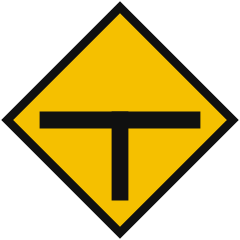
11. On which approach is this sign normally installed?
Show answer
Answer C: On the road that ends, far enough ahead for the driver to slow down
The warning belongs on the approach that terminates, placed early enough that the driver can lose speed and choose a direction before reaching the junction.
-
12. How far forward should a rider sit on the seat?
Show answer
Answer D: Far enough forward that the arms are slightly bent on the grips
Slightly bent arms let the rider steer with the handlebars instead of using the arms to prop up the upper body.
-
13. You are approaching a highway-rail grade crossing marked only with a crossbuck sign. What does that sign require?
Show answer
Answer A: Yield to any approaching train and cross only when the tracks are clear
The crossbuck is a regulatory yield sign, and a train can never stop or steer around a vehicle, so the driver must always give way.
-
14. An ambulance has just gone by and traffic starts to move again. Why should you wait a moment before pulling back out?
Show answer
Answer B: Another emergency vehicle may be following the first one
Emergency calls often bring several vehicles, so check that nothing else is coming before you rejoin the traffic lane.
-
15. Why should you avoid parking over tall dry grass or a pile of dead leaves?
Show answer
Answer B: Because the hot exhaust can set the dry material on fire
The exhaust system stays hot for a long time after a drive and can ignite dry vegetation underneath the vehicle.
-
16. Which clue best warns a rider that the door of a parked car is about to open?
Show answer
Answer B: Someone visible in the seat, or exhaust showing at the tailpipe
Occupied cars are the ones that open doors, so scan through rear windows and mirrors and look for exhaust or wheels turning as you approach.
-
17. Why should riding clothing have no loose flapping parts?
Show answer
Answer B: Loose cloth can catch on the machine, and flapping tires the rider
Loose fabric can snag on the controls, the chain or a wheel, and the constant flapping and noise wear the rider out over a long ride.
-
18. You have dropped some distance behind the rest of your group. What should you do?
Show answer
Answer C: Keep your own safe pace, because the group should slow to bring you back
Chasing the group means riding beyond a comfortable pace, so the responsibility sits with the leader to slow down until the formation is whole again.
-
19. What should a passenger be told about where to keep their legs?
Show answer
Answer D: To keep them away from the muffler, the chain and other moving parts
Exhaust pipes get hot enough to burn and exposed drive components can catch a loose leg, so the passenger must keep legs in and clear of them.
-
20. How long must a Minnesota driver hold the reduced speed the Move Over law requires?
Show answer
Answer A: Until the vehicle has completely passed the stopped vehicle
Minnesota Statutes 169.18 requires the reduced speed to be maintained until the motor vehicle has completely passed the parked or stopped authorized vehicle.
-
21. What makes up the total distance needed to bring a vehicle to a stop?
Show answer
Answer A: The distance covered while you perceive the hazard, the distance covered while you react, and the braking distance
Total stopping distance combines the ground covered while you notice the hazard, the ground covered while you move your foot to the brake, and the ground covered while the brakes slow the vehicle.
-
22. Why is smooth, early braking better than hard, late braking?
Show answer
Answer D: It keeps you in control and gives the driver behind more warning
Braking early and gently keeps the tires well within their grip and gives following drivers time to react to your brake lights.
-
23. Why are dawn and dusk especially difficult times to be seen on a motorcycle?
Show answer
Answer A: Low contrast light makes a small vehicle blend into the scene
In the flat light of dawn and dusk a motorcycle blends into its background, so bright color, reflective material and the headlight matter most at exactly those hours.
-
24. What is the correct body position for riding over a bump or an obstacle?
Show answer
Answer B: Rise slightly off the seat with your weight on the footrests, absorbing the shock with knees and elbows
Coming slightly off the seat lets your legs and arms work as extra suspension instead of transferring the impact through your body and the handlebars.
-
25. A sign beside the signal reads STOP HERE ON RED. What does it tell you?
Show answer
Answer B: Stop at that point on red, not closer to the intersection
The sign marks the required stopping point, which is set back from the corner so that turning vehicles and sight lines are not blocked.
-
26. Why does riding in moderately cold weather call for extra layers of clothing?
Show answer
Answer B: Chill and fatigue set in quickly and reduce the rider's control
Wind at riding speed strips body heat away fast, and a chilled, tired rider reacts more slowly and can slide into hypothermia.
-
27. You are driving at night on an unlit road using low beams. How should you choose your speed?
Show answer
Answer C: So you could stop within the distance your headlights light up
Driving faster than you can stop within the lit area is called overdriving your headlights. Anything beyond the beam is invisible until it is too late to react.
-
28. Why does even a small reduction in speed matter so much where people are walking?
Show answer
Answer D: Because a pedestrian struck at a lower speed is far more likely to survive
The chance that a pedestrian survives falls steeply as impact speed rises, so a few miles per hour can decide the outcome.
-
29. What happens to a motorcycle's ground clearance when a passenger is carried?
Show answer
Answer A: It is reduced, so parts touch down at a smaller lean angle
The extra load compresses the suspension and lowers the machine, so footrests and other parts can drag on the road sooner in a turn.
-
30. What counts as a complete stop at a stop sign?
Show answer
Answer C: The wheels stop turning before the stop line
A legal stop means the vehicle is no longer moving, made at the stop line or before entering the crosswalk or intersection.
-
31. At an intersection that uses a lagging left turn, when is the left-turn arrow displayed?
Show answer
Answer B: After the through movement has run
A lagging left turn phase runs at the end of the green rather than the start, so a driver waiting to turn should not assume the arrow has been missed.
-
32. Your green left-turn arrow goes out and a steady green ball stays lit. What may you do?
Show answer
Answer A: Continue turning left, but only after yielding to oncoming traffic
When the arrow ends and a green ball remains, the turn changes from protected to permissive, so it is still allowed but oncoming traffic goes first.
-
33. Traffic is backed up on the far side of a railroad crossing. What should you do before driving onto the tracks?
Show answer
Answer D: Wait behind the tracks until there is room to clear them completely
Never enter a crossing until you are certain you can drive completely across without stopping, because a vehicle trapped on the tracks cannot get out of a train's way.
-
34. You are already inside a roundabout when an emergency vehicle approaches with lights and siren. What should you do?
Show answer
Answer B: Continue to your exit, leave the roundabout, then pull over and stop
Stopping inside a roundabout blocks the circulating roadway, so you should exit first and then pull over clear of the intersection.
-
35. Is it acceptable to drive far below the flow of traffic on an open highway?
Show answer
Answer B: No, driving too slowly can obstruct traffic and create a hazard
Traffic that is much slower than the surrounding flow forces other drivers into sudden braking and unnecessary passing maneuvers, and impeding traffic is itself a violation.
-
36. You are traveling beside another vehicle on a multilane highway at nearly the same speed. Why is this a poor position?
Show answer
Answer B: You may be sitting in that driver's blind spot with nowhere to go if they move over
Driving alongside removes your side escape route and often puts you where the other driver cannot see you. Speed up or drop back to open space beside you.
-
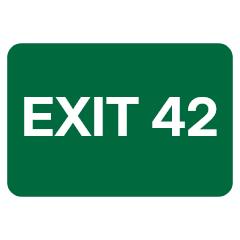
37. Where is signing of this kind normally placed along a freeway?
Show answer
Answer D: Ahead of the interchange and again at the exit, so a driver can reach the correct lane in time
Guide information for an interchange is repeated on the approach and at the ramp, because a driver who learns about the exit only at the last moment has no room left for a safe lane change.
-
38. You are behind a snow plow working on a highway. What is the correct way to drive?
Show answer
Answer C: Stay well back and do not try to pass it
A plow throws snow, runs wider than its body and works on the poor surface ahead of it, so the cleared road behind it is the safest place to be.
-
39. Why can a motorcycle ahead of you slow down without any warning light showing?
Show answer
Answer B: The rider may slow by downshifting or rolling off
Riders often lose speed by closing the throttle or changing down, which does not switch on the brake light, so watch the machine itself and keep back.
-
40. At night you are judging your distance from the rider ahead by their tail light. What is the risk?
Show answer
Answer A: A single small light gives a poor sense of how far away it really is
Distance is very hard to judge from one small light in the dark, so riders should leave extra space rather than trust the impression the light gives.