
Minnesota DVS Motorcycle Practice Test 11
- Questions40
- Correct to pass32
- Passing score80%
- Minimum age16 years
-
1. On a narrow residential street, why does parking tight against the curb matter so much?
Show answer
Answer C: Because fire trucks and ambulances need the width to get through
Cars parked even a foot out from the curb on both sides can narrow a street until a fire truck or ambulance cannot pass.
-
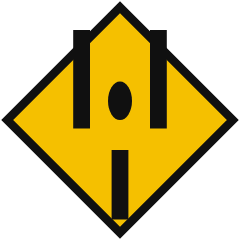
2. Beyond the point this sign refers to, which movement becomes unlawful?
Show answer
Answer D: Driving on the far side of the separation, against the flow
Once the two directions are separated, each roadway carries one-way traffic, so crossing to the other side means driving into oncoming vehicles.
-
3. A stop sign at a busy corner has a stop line and a crosswalk, but buildings block your view of the cross street. What is the correct sequence?
Show answer
Answer C: Stop at the line first, then edge forward and stop again to see
The first stop is required at the line or before the crosswalk, and a second stop farther forward is what actually lets you yield safely.
-
4. When should a rider add a layer on a ride that is turning cold?
Show answer
Answer D: Before you start to feel cold, at the next convenient stop
Once a rider is chilled it takes a long time to warm up again, and cold hands and slowed reactions cost control, so add layers before the cold takes hold.
-
5. Why should a rider glance down at the sidestand before pulling away?
Show answer
Answer A: A stand left down can catch the road and lever the rear wheel off the ground
A sidestand that is still down will dig into the pavement in a left turn and can lift the rear tire clear of the road.
-
6. What is the proper use of the horn?
Show answer
Answer C: To give a brief warning when another road user may not have seen you
The horn is a warning device meant to alert someone to your presence when a collision is possible, and using it in anger tends to escalate conflict rather than prevent crashes.
-
7. Your vehicle has stalled on railroad tracks and no train is in sight. After getting everyone away, whom should you call first?
Show answer
Answer B: The railroad emergency number posted on the blue sign at the crossing, giving the crossing number
Every public crossing has a blue emergency notification sign with a phone number and a crossing identification number. That call lets the railroad stop or slow trains before they reach you.
-
8. You are in a marked passing zone but a steady stream of oncoming traffic is coming toward you. What does the broken center line allow?
Show answer
Answer C: A pass only when the road is clear, so you have to stay behind
A passing zone marks where the sight distance is adequate, but it never gives permission to enter a lane that another vehicle is occupying.
-
9. You are approaching a traffic light that has been green for a long time. How should you treat it?
Show answer
Answer C: Expect it to change and be ready to stop
A light that has been green for a while is called a stale green light. Cover the brake and decide in advance where you could still stop safely.
-
10. What does a sign reading Slower Traffic Keep Right require?
Show answer
Answer C: Traffic moving slower than the general flow must use the right-hand lane
The sign applies to any vehicle traveling below the speed of the traffic around it, which must keep right so faster vehicles can use the lanes to the left.
-
11. You are starting from a stop on a snowy, icy street and the drive wheels begin to spin. What should you do?
Show answer
Answer C: Ease off the accelerator and start again more gently
Spinning tires polish the surface and dig in. Very gentle pressure on the accelerator, and a higher gear if you have one, gives the tires the best chance to grip.
-
12. You are driving on an open highway in a strong crosswind. What is the safest adjustment?
Show answer
Answer A: Reduce speed and keep a firm grip, expecting gusts on bridges and beside large vehicles
Gusts hit hardest in open gaps, on bridges and when passing high-sided vehicles, so a lower speed and a firm grip let you correct before you are pushed out of your lane.
-
13. The engine has warmed up and idles smoothly. What should be done with the choke?
Show answer
Answer C: Turn it off
A warm engine running on a rich mixture wastes fuel, runs poorly and can foul the spark plugs, so the choke is closed once it is no longer needed.
-
14. How close to a fire hydrant may a vehicle be parked in Minnesota?
Show answer
Answer D: No closer than 10 feet
Minnesota Statutes 169.34 prohibits stopping, standing or parking within ten feet of a fire hydrant.
-
15. There is a stop sign but no stop line and no crosswalk. Where must you stop?
Show answer
Answer A: Before entering the intersection, where you can see cross traffic
With no line or crosswalk, stop before you enter the intersection at the point where you can see traffic on the cross street.
-
16. A center lane is marked with a broken yellow line on each side and is controlled by overhead lane signals. How is that lane used?
Show answer
Answer A: It carries traffic one way or the other according to the signals
A reversible lane is marked with broken yellow lines on both sides and its direction of travel is set by the lane control signals above it.
-
17. A driver has to stop for a train at this sign. How far back from the nearest rail should the vehicle be held?

Show answer
Answer C: No closer than roughly fifteen feet
A train and its load overhang the rails, so stopping no closer than about fifteen feet keeps the vehicle outside the space the train actually sweeps.
-
18. What is the correct order of a pass on a two-lane road?
Show answer
Answer A: Check ahead and behind, signal left, move out, accelerate past, signal right and return
A pass begins with the decision that the road is clear and ends with a signaled return, and each step warns other drivers before the vehicle moves.
-
19. Why should pant legs be secured and bootlaces tucked away?
Show answer
Answer A: Loose fabric and laces can tangle in the chain, the controls or a wheel
Anything hanging near the moving parts of a motorcycle can be caught and pulled in, which can trap a foot or lock the rear wheel.
-
20. On the Interstate system, what do the odd-numbered one and two digit routes have in common?
Show answer
Answer D: They run mainly north and south
Odd numbers are given to north and south Interstates and even numbers to east and west ones, with the numbers rising toward the north and the east.
-
21. Why is texting considered one of the most dangerous distractions?
Show answer
Answer B: It combines visual, manual and cognitive distraction at the same time
Reading or writing a message takes your eyes off the road, at least one hand off the controls and your attention off driving simultaneously.
-
22. Which combination best reduces the chance of hydroplaning?
Show answer
Answer D: Good tread depth, correct tire pressure and lower speed in the rain
Tread channels water away, correct pressure keeps the tire's shape, and lower speed gives the tire time to push water aside. Hydroplaning can begin at surprisingly modest speeds.
-
23. What does the thick foam liner inside a certified helmet actually do in a crash?
Show answer
Answer C: It crushes so the head slows down over a longer time and distance
The crushable liner is the part that absorbs energy, letting the head decelerate gradually instead of stopping instantly against a hard surface.
-
24. What is the main danger of grabbing the front brake lever abruptly?
Show answer
Answer D: The front wheel can lock, and a locked wheel cannot steer or balance
The front brake must be squeezed progressively so that weight transfers onto the front tire before full braking force is asked of it.
-
25. What does research say about the effect of a full coverage helmet on a rider's ability to see and hear traffic?
Show answer
Answer B: It leaves the view and the useful hearing a rider needs largely intact
Certified helmets leave far more peripheral vision than a rider needs to check traffic, and riders wearing them still hear the sounds that matter.
-
26. You are hosting a party and a guest who has been drinking wants to drive home. What should you do?
Show answer
Answer D: Stop serving and arrange a ride or a bed
Only time removes alcohol, so a host who wants to prevent a crash has to remove the driving, not try to speed up sobering that cannot be sped up.
-
27. Which of these is an early warning that you are too tired to keep driving?
Show answer
Answer C: Not remembering the last few miles you drove
Memory gaps, repeated yawning, heavy eyelids and drifting are the body signaling that sleep is winning, and they mean stop rather than push on.
-
28. A rider chooses an open face helmet. What does that choice make necessary?
Show answer
Answer A: Separate goggles or a face shield, because the face is uncovered
An open face helmet gives no eye or face protection, so the rider must add goggles or a face shield that will not shatter and that seals against the wind.
-
29. An overhead sign shows that the right lane is EXIT ONLY. What does that mean if you intend to stay on the highway?
Show answer
Answer B: You have to move out of that lane before the exit
An exit only lane leaves the highway completely, so a driver continuing on the highway has to change lanes before it does.
-
30. How does braking distance change if you double your speed?
Show answer
Answer D: It grows much more than twice as long
Braking distance increases with the square of speed, so doubling speed roughly quadruples the distance needed to stop.
-
31. At 45 mph you look at a navigation screen for four seconds. Roughly how far do you travel unseeing?
Show answer
Answer D: About 260 feet
At 45 mph you cover roughly 66 feet a second, so four seconds on a screen is around 260 feet of road that you never looked at.
-
32. What do zero tolerance laws mean for a driver who is under 21?
Show answer
Answer B: They commit a violation at an alcohol level far below the adult limit
Drivers under 21 may not legally drink, so every state sets a limit far below the adult one and treats even a trace reading as a violation. The exact figure is set by each state, and the penalty usually includes losing the license.
-
33. When must a Minnesota motorcyclist wear protective eyewear?
Show answer
Answer B: Always, even when the motorcycle has a windshield
Minnesota requires glasses, goggles or a face shield even when the motorcycle is fitted with a windshield, and contact lenses do not satisfy the requirement.
-
34. How much room must a Minnesota driver leave when overtaking a bicycle going the same way?
Show answer
Answer A: At least three feet
Minnesota Statutes 169.18 requires a safe distance and in no case less than three feet of clearance when overtaking a bicycle.
-
35. You are riding where fresh pavement meets an older lane that sits an inch or two lower. How should you move across that edge?
Show answer
Answer A: Slow down and cross the edge at as sharp an angle as the lane allows
A pavement edge break can steer the front wheel along it if you meet it at a shallow angle, so slow, hold the bars firmly and cross it steeply.
-
36. You are approaching an intersection in a line of traffic. What can you do to be more visible to a driver waiting to pull out?
Show answer
Answer D: Move to a lane position where you are not hidden behind the vehicle ahead
A motorcycle tucked directly behind a larger vehicle is invisible to a waiting driver until the moment it appears, so the rider moves to where the headlight can be seen.
-
37. What is the Minnesota speed limit on an interstate highway inside the limits of an urbanized area?
Show answer
Answer C: 65 mph
Minnesota Statutes 169.14 sets 65 miles per hour on interstate highways inside urbanized areas.
-
38. What changes most when a rider moves from a light motorcycle to a much heavier one?
Show answer
Answer A: It takes longer to stop and is harder to hold up at low speed
Extra mass means longer stopping distances and more effort in slow maneuvers and when holding the machine up, so build up gradually on an unfamiliar heavy motorcycle.
-
39. Where should a touring rider keep the rain suit?
Show answer
Answer B: Somewhere it can be reached quickly without unpacking everything
Rain gear only helps if you can get to it before you are soaked, so pack it where a quick roadside stop is enough to reach it.
-
40. Some states allow a left turn against a red light. Which movement is it?
Show answer
Answer A: A left turn from a one-way street onto another one-way street
The movement generally allowed on red is one-way to one-way, because the turn does not cross any lane of oncoming traffic; a few states also extend it to a two-way street turning onto a one-way street.