
Minnesota DVS Motorcycle Practice Test 12
- Questions40
- Correct to pass32
- Passing score80%
- Minimum age16 years
-
1. A white regulatory sign shows the silhouette of a truck inside a red circle with a diagonal slash. What does it mean?
Show answer
Answer A: Trucks are not allowed to use that road
The circle and slash over a symbol always means the movement or vehicle shown is prohibited, so trucks must keep off that roadway.
-
2. Why is a shoulder check especially important on a road with motorcycles and bicycles?
Show answer
Answer D: A narrow vehicle can disappear completely in the blind spot
A motorcycle or a bicycle is small enough to be hidden entirely by a door pillar or by the blind spot the mirrors do not cover.
-
3. A sign with a blue background and a white legend and border tells road users about
Show answer
Answer A: services such as fuel, food, lodging, hospitals and rest areas
Blue is the background of the general service series, which points travelers toward the services available along or near the route.
-
4. How should a group merge onto a busy highway from an entrance ramp?
Show answer
Answer D: One rider at a time into gaps in traffic, re-forming once all are on
Each rider needs a gap and enough speed of their own, so the group merges individually and only takes up the staggered formation again afterward.
-
5. When are the hazard warning lights properly used?
Show answer
Answer A: When your vehicle is stopped or barely moving and is a hazard
Hazard lights warn that your vehicle is an obstruction; they do not authorize illegal parking and they hide your turn signals while driving.
-
6. Why do watering eyes matter so much to a rider?
Show answer
Answer D: Blurred vision delays the moment you see and react to a hazard
Wind makes unprotected eyes water, and even a brief loss of clear vision at road speed costs you the distance you need to react.
-
7. When may a Minnesota driver hold and use a phone in the hand while driving?
Show answer
Answer B: To obtain emergency help for a crash, a medical emergency or a road hazard
Minnesota Statutes 169.475 excepts use to obtain emergency assistance, including reporting a crash, a medical emergency, a serious road hazard or criminal activity.
-
8. Which headlight setting should you use in dense fog?
Show answer
Answer B: Low beams
High beams reflect off the water droplets in fog and bounce glare back at you, while low beams aim downward and light the road without that mirror effect.
-
9. You are on a city street with two lanes in your direction, cars parked along the curb and driveways every few yards. Which lane is usually safer?
Show answer
Answer B: The lane farther from the curb, away from opening doors and vehicles pulling out
Most of the hazards on such a street come from the curb side, so the inside lane gives you more space and more time to react.
-
10. You notice that the driver ahead of you is holding a phone to the ear. What should you do?
Show answer
Answer C: Assume slower reactions and leave extra space, or else hold back
A driver on the phone reacts late and misses things, so the safe response is distance rather than a lesson.
-
11. The green arrow protecting your turn changes to a steady yellow arrow. What is it telling you?
Show answer
Answer A: The protected turn is ending and you should prepare to stop
A steady yellow arrow warns that the arrow movement is being terminated and that a red indication will follow.
-
12. You are driving on a road covered with a layer of wet fallen leaves. What should you expect?
Show answer
Answer B: As little grip as on ice, plus hidden markings and hidden holes
Wet leaves are as slippery as ice and they hide the lane lines and any potholes underneath, so slow well before curves and stops.
-
13. What should be done with a group that has grown too large to manage?
Show answer
Answer D: Split it into smaller groups, each with its own leader and sweep rider
Smaller sub groups stay together more easily and are easier for other drivers to pass, and each one needs its own leader and sweep rider.
-
14. At roughly what speed can hydroplaning begin when a lot of water is lying on the road?
Show answer
Answer C: At speeds as low as about 35 mph
With enough water and less than perfect tread, a tire can start to ride on the water at around 35 mph, well below normal highway speeds.
-
15. A sign showing a figure with an outstretched thumb inside a red circle with a slash means that
Show answer
Answer B: soliciting a ride is prohibited there
The no hitchhiking sign bars standing beside the road to solicit a ride, and it is common along freeway ramps and shoulders.
-
16. Snow has covered the pavement markings on a two-lane road. How should a driver judge lane position?
Show answer
Answer B: By the tracks of other traffic and the roadside features
With the markings hidden, ruts left by earlier traffic, signs, poles and the line of the shoulder are the best clues to where the lane runs.
-
17. Your motorcycle starts to wander while you ride over rain grooves or a bridge grating. What should you do?
Show answer
Answer A: Relax, hold a steady speed and ride straight across
The wandering feeling on grooved surfaces and gratings is unsettling but generally not hazardous, while zigzagging to fight it is far more dangerous.
-
18. Two drivers each have three drinks, one over three hours and one in half an hour. What is the difference?
Show answer
Answer C: The fast drinker reaches a higher peak level
The liver removes alcohol at a steady rate, so drinking faster than the body can clear it pushes the blood alcohol level much higher.
-
19. You have a green light and are turning right while people are crossing the street you want to enter. Who goes first?
Show answer
Answer B: The pedestrians, and you wait until they are clear of your path
A green light permits the turn but does not remove the duty to yield to pedestrians already crossing the street you are turning into.
-
20. Which shape is used for the school advance warning sign and the school crossing sign?
Show answer
Answer B: An upward-pointing pentagon
The five-sided pentagon with its point up identifies school signing, so the outline alone tells a driver that children may be present.
-
21. How far ahead should you normally be looking while driving?
Show answer
Answer D: About 12 to 15 seconds of travel ahead
Looking that far ahead, roughly a block in town and much farther on a highway, gives you time to see a problem developing and adjust before it becomes an emergency.
-
22. A pedestrian using a white cane or walking with a guide dog starts to cross the street ahead of you. What must you do?
Show answer
Answer A: Yield and stay stopped until the person has finished crossing
A white cane or guide dog identifies a pedestrian who may not be able to see your vehicle, so you must yield and wait rather than maneuver around the person. The horn can confuse the pedestrian or the dog.
-
23. What is the best path through a curve where you can see all the way to the exit?
Show answer
Answer A: Start toward the outside, move toward the inside, then drift back out
Entering wide, cutting toward the inside and running back out straightens the path, which means less lean angle for the same speed and a better view.
-
24. What additional fine applies in Minnesota after two or more convictions for messaging while driving?
Show answer
Answer C: 275 dollars
A driver convicted of two or more violations of using a wireless device to compose, read or send messages must pay a 275 dollar fine in addition to the court-specified fine.
-
25. Why should riders avoid the center strip of the lane, especially where traffic stops often?
Show answer
Answer A: Because it collects oil and grease dripped from other vehicles
Drippings from other vehicles build up in the center of the lane, and the buildup is heaviest at busy intersections and toll booths where traffic sits waiting.
-
26. Which set of qualities should eye protection for riding have?
Show answer
Answer A: Shatter resistant, free of scratches, and sealed against the wind
Riding eye protection has to survive an impact, let you see clearly and keep the air out, which is why plastic face shields and goggles are used instead of ordinary glasses.
-
27. You are riding alongside a car in the next lane at the same speed. What is the problem?
Show answer
Answer B: You may be sitting in the driver's blind spot with nowhere to escape
A driver who cannot see the motorcycle may change lanes into it, so riders adjust speed to move ahead of or behind the vehicle instead of staying beside it.
-
28. Which statement about standard drinks is correct?
Show answer
Answer C: A standard serving of beer, of table wine and of distilled spirits each contain about the same amount of pure alcohol
Roughly 12 ounces of regular beer, 5 ounces of table wine and 1.5 ounces of 80 proof spirits each contain about the same amount of pure alcohol, so the type of drink does not change the effect.
-
29. You come upon a person riding a horse on the roadway ahead of you. What is the correct way to pass?
Show answer
Answer A: Slow down, give plenty of room and do not use the horn
Horses startle easily, and a frightened horse can throw its rider into your path. Pass slowly and wide, and avoid any sudden noise.
-
30. How should a passenger swing their leg when getting off the motorcycle?
Show answer
Answer D: High and clear of the exhaust and the rear of the machine
A leg dragged low across the back of the motorcycle can catch the seat or the luggage and will find the hot exhaust, so it is lifted well clear.
-
31. A police officer in the intersection raises a hand toward you although your signal is green. What should you do?
Show answer
Answer B: Stop and wait for the officer to wave you on
An officer directing traffic overrides signals and signs, and drivers must follow the officer even when the light says otherwise.
-
32. A school crossing guard has returned to the curb but two children are still walking across the road. When may you go?
Show answer
Answer C: Only after the children have reached the far sidewalk
The guard leaving the road does not end your duty; you stay stopped until every child is clear of the roadway.
-
33. You receive a phone call that you feel you must answer while driving. What is the safest way to take it?
Show answer
Answer D: Pull off the road, stop in a safe place and then answer
No call is worth a crash. Stopping in a safe location removes the distraction completely, while every other option divides your attention.
-
34. A driver reaching a stop sign is required to do what?
Show answer
Answer D: Come to a complete stop and then proceed only when it is safe
A stop sign requires a full stop before the stop line, crosswalk or intersection, after which the driver may go on once the way is clear.
-
35. An arrow panel at a work zone displays a flashing arrow pointing to the left. What does it require?
Show answer
Answer C: Move out of the closed lane into the lane on the left
A flashing or sequential arrow on an arrow panel directs traffic out of a closed lane and into the lane the arrow points to.
-
36. How does alcohol typically affect a driver's vision?
Show answer
Answer D: It blurs vision, weakens night vision and narrows attention to the sides
Alcohol slows the eye muscles and the brain's processing of what is seen, degrading focus, night vision, depth perception and awareness of movement at the edges of the field of view.
-
37. Which vehicles must display the Minnesota slow-moving vehicle emblem?
Show answer
Answer B: Vehicles designed to operate at 35 mph or less
Minnesota Statutes 169.522 requires the emblem on animal-drawn vehicles, implements of husbandry and other machinery designed for a speed of 35 miles per hour or less.
-
38. How do worn tires and worn brakes affect your ability to stop?
Show answer
Answer C: They lengthen the stopping distance, especially on a wet road
Worn tread cannot clear water and worn brakes cannot produce full force, so both stretch the distance needed to stop.
-
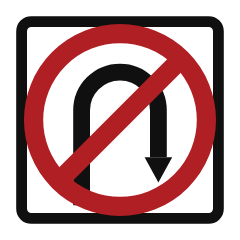
39. Why is this restriction used so often on a divided road just before a crest or a bend?
Show answer
Answer A: Because a vehicle turning across the median there stays hidden from approaching drivers until it is too late
The maneuver needs a long gap and good visibility, and where sight distance is short an approaching driver has no time to react to a vehicle turning across the road.
-
40. What is a marked loading zone for?
Show answer
Answer A: Loading and unloading only, not for general parking
A loading zone is reserved for actively loading or unloading goods or passengers; leaving a vehicle there for other reasons is a parking violation.