
Minnesota DVS Motorcycle Practice Test 2
Test 2 of 6. Pick an answer for each question to see if it is right and why; your score appears at the end. You need 32 correct answers to pass, the same ratio as the real Minnesota test.

- Questions40
- Correct to pass32
- Passing score80%
- Minimum age16 years
-
1. A sign with a green background and a white legend normally provides
Show answer
Answer A: directions, distances and destinations
Green is the background color of the guide sign series, which names routes and destinations and gives the distance to them.
-
2. What is the correct way to think about protective gear?
Show answer
Answer D: It reduces injury in a crash but does nothing to prevent one
Gear is the last line of defense. Avoiding the crash depends on skill, speed choice, space and visibility, and gear only limits the damage when those fail.
-
3. The leader gives a hand signal that you can see clearly from your place in the group. What should you do with it?
Show answer
Answer A: Repeat the signal so the riders behind you also receive it
Signals are passed down the line rider by rider, because riders further back cannot see the leader through the machines in between.
-
4. An emergency vehicle approaches with lights and siren on a Minnesota one-way street. What must the driver do?
Show answer
Answer B: Move to the closest edge or curb and stop
On a one-way roadway Minnesota Statutes 169.20 directs the driver to the closest edge or curb rather than always to the right.
-
5. You reach a stop-controlled intersection at the same time as a driver on your left, but that driver is already moving through the crossing. Who goes first?
Show answer
Answer C: The driver who is already inside the intersection
A vehicle already in the intersection has the right of way, and the rule about yielding to the right applies only before anyone has entered.
-
6. Why is it risky to brake hard and steer sharply at the same moment?
Show answer
Answer C: The tires have a limited amount of grip that braking and turning must share
Each tire can deliver only so much grip, and asking it to slow the vehicle and change direction at once can exceed that limit and start a skid.
-
7. You are parking on a one-way street where parking is allowed on both sides. What must still be true?
Show answer
Answer D: The vehicle must face the direction the traffic flows
Either curb may be used on a one-way street where signs allow it, but the vehicle must always be headed in the direction traffic moves.
-
8. Which alcohol concentration counts as an aggravating factor in a Minnesota impaired driving case?
Show answer
Answer B: 0.16 or more
Minnesota Statutes 169A.03 defines an alcohol concentration of 0.16 or more, measured at the time of the offense or within two hours of it, as an aggravating factor.
-
9. How far ahead should you normally be looking while driving?
Show answer
Answer D: About 12 to 15 seconds of travel ahead
Looking that far ahead, roughly a block in town and much farther on a highway, gives you time to see a problem developing and adjust before it becomes an emergency.
-
10. You stop behind another vehicle at a traffic light. How much space should you leave?
Show answer
Answer D: Enough to see where its rear tires touch the pavement
Seeing the rear tires on the road leaves room to steer around the vehicle if it stalls, and gives a cushion if you are struck from behind.
-
11. Which action makes a wobble worse instead of better?
Show answer
Answer A: Braking or accelerating to try to ride out of it
Braking or adding power during a wobble can amplify it. Close the throttle gradually, hold the bars firmly and let the speed fall until the machine settles.
-
12. Why should you stay out of an intersection you cannot clear, even on a green light?
Show answer
Answer B: Because you would block cross traffic when their signal turns green
A vehicle stranded in the intersection blocks the cross street when its light turns green, which stalls the whole junction and traps emergency vehicles.
-
13. A center lane is bordered by a solid yellow line on the outside and a broken yellow line on the inside, with left-turn arrows painted in it. How may you use that lane?
Show answer
Answer A: Only to make a left turn or to prepare for one from either direction
That marking identifies a two-way left turn lane, which may only be used for left turns or to prepare for a left turn and never for travel or passing.
-
14. Besides the hours from sunset to sunrise, when does Minnesota require headlights?
Show answer
Answer C: When people and vehicles cannot be clearly seen at 500 feet
Minnesota Statutes 169.48 requires lighted lamps whenever weather or other conditions leave persons and vehicles not clearly discernible at 500 feet.
-
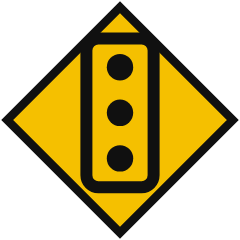
15. A driver passes this sign and the signal beyond it is already showing green. What is the safest response?
Show answer
Answer C: Ease off the accelerator and be ready to stop, because an indication that has been showing for a while is about to change
A signal that has been displaying the same indication for some time is close to changing, so arriving at a controlled speed with the brake covered is safer than accelerating to beat it.
-
16. Another driver takes a right of way that was legally yours. What should you do?
Show answer
Answer A: Give way to the other driver and avoid the crash, whatever the law says
Right of way is something you give, not something you take, and being in the right is no protection in a collision.
-
17. You are turning onto a street that has two lanes going your way. Which lane should you enter?
Show answer
Answer B: The lane closest to you, changing lanes later if you need to
Turn into the nearest lane going your direction and make any lane change afterwards, when you have signaled and checked that it is clear.
-
18. You are on a one-way street with two marked lanes. May you pass a slower vehicle on the right?
Show answer
Answer A: Yes, using the right lane, provided that the move is safe and signaled
On a roadway with two or more marked lanes in your direction, moving into the free lane and going by is a normal lane change rather than an unlawful pass.
-
19. Enhanced reference location markers differ from ordinary mileposts in that they
Show answer
Answer B: carry the route number and a mileage figure to the tenth of a mile
An enhanced reference location marker adds the route designation and carries the mileage to a tenth, so the point named is far more precise than a plain milepost.
-
20. You are turning left into a street that is divided by a raised median. Which side should you enter?
Show answer
Answer C: The right-hand roadway, so that you travel on the proper side
A raised median separates two directions of travel, so the turn must be completed into the roadway carrying traffic your way.
-
21. Within what range may a Minnesota local authority set a school speed limit?
Show answer
Answer A: 15 to 30 mph
Minnesota Statutes 169.14 lets local authorities establish school speed limits of between 15 and 30 miles per hour in a school zone.
-
22. Why does full riding gear matter on a short trip around the neighborhood?
Show answer
Answer D: Pavement takes skin off at 25 miles an hour just as it does at 55
Serious injuries happen at ordinary street speeds and close to home, so gear that is worth wearing on a long trip is worth wearing on a short one.
-
23. Where should you be looking as you steer through a turn?
Show answer
Answer C: Toward the point on the new road where you want to end up
Drivers steer toward what they look at, so looking through the turn to where you want to go keeps the path smooth and accurate.
-
24. A pedestrian is crossing in a marked Minnesota crosswalk. What must an approaching driver do?
Show answer
Answer A: Stop and stay stopped until the pedestrian has cleared the lane
Minnesota Statutes 169.21 requires the driver to stop to yield to a pedestrian in a marked crosswalk or at an intersection with no marked crosswalk and to remain stopped until the pedestrian has cleared the lane.
-
25. What minimum light transmittance does Minnesota require through a tinted side or rear window?
Show answer
Answer D: 50 percent
Minnesota Statutes 169.71 prohibits material with a light transmittance of less than 50 percent, plus or minus three percent, on side and rear windows.
-
26. Under Minnesota law, a motorcycle may overtake another vehicle within the same traffic lane only under which conditions?
Show answer
Answer A: At no more than 25 mph and no more than 15 mph over the speed of traffic
Minnesota Statutes section 169.974 permits passing within the same traffic lane only when the motorcycle travels at no more than 25 mph and no more than 15 mph above the speed of surrounding traffic, and riding between lanes remains prohibited.
-
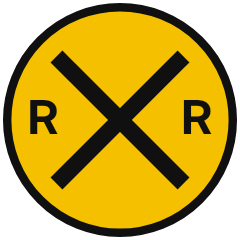
27. Where is this sign installed in relation to the hazard it announces?
Show answer
Answer A: Far enough before the hazard that a driver can slow down and stop short of it
This is an advance warning sign, placed on the approach so a driver has time to react before reaching a crossing that a curve or a crest may be hiding.
-
28. You are following closely behind a vehicle you intend to pass on a two-lane road. What should you do first?
Show answer
Answer D: Drop back to give yourself room to build speed before you pull out
From close behind you cannot see far enough ahead and you have no room to gather speed, so the pass takes longer and starts blind.
-
29. A shared-use path crosses the road ahead at a marked crossing and people are already crossing on it. What should you do?
Show answer
Answer C: Yield and let them finish crossing the road
People already crossing at a marked crossing have the right of way, and a path crossing is a crossing of the roadway like any other.
-
30. How should you handle a prescription or over the counter medicine before driving?
Show answer
Answer D: Read the label and ask a pharmacist or doctor whether it affects driving
Many common medicines, including allergy and cold remedies, cause drowsiness or slowed reactions, and the label or a pharmacist can tell you whether driving is safe.
-
31. Your vehicle is burning at the roadside. How far away should everyone keep?
Show answer
Answer D: At least a hundred feet away from the vehicle and upwind, out of the drifting smoke
Burning vehicles give off toxic smoke and parts such as tires and struts can burst, so keep a long distance and stay upwind.
-
32. How may a Minnesota driver use a navigation app while the vehicle is in motion?
Show answer
Answer C: By viewing it without holding the device or typing on it
Minnesota Statutes 169.475 permits viewing a global positioning or navigation system as long as the driver neither types on it nor holds it.
-
33. Fog thickens until you can barely make out the vehicle ahead. What is the safest action?
Show answer
Answer A: Slow right down and, if needed, leave the road at a safe place
In heavy fog the only safe speed may be very low, and if it drops below what the road allows, the answer is to pull well clear of the traffic lanes.
-
34. You are parked legally, but a police officer tells you to move the vehicle. What should you do?
Show answer
Answer B: Move it as directed, because an officer overrides the signs
Directions from a police officer or a firefighter take precedence over signs and markings, whether they are directing traffic or clearing a street.
-
35. A driver is following you far too closely. What is the best response?
Show answer
Answer D: Increase your own following distance and let the driver pass when it is safe
More room ahead of you means you can slow gradually instead of braking hard, which reduces the chance of being struck from behind, and letting the driver by removes the problem entirely.
-
36. A large panel mounted on a trailer at the roadside displays a flashing arrow pointing left. What does it tell you?
Show answer
Answer B: Move into the lane to your left
An arrow panel directs traffic out of a closed lane, so the arrow shows the direction you must move rather than the shape of the road ahead.
-
37. How close to a fire hydrant may a vehicle be parked in Minnesota?
Show answer
Answer D: No closer than 10 feet
Minnesota Statutes 169.34 prohibits stopping, standing or parking within ten feet of a fire hydrant.
-
38. Who is exempt from Minnesota's hands-free law while performing official duties?
Show answer
Answer A: The operator of an authorized emergency vehicle
Minnesota Statutes 169.475 excepts the operator of an authorized emergency vehicle acting in the course of official duties.
-
39. How long must a Minnesota driver hold the reduced speed the Move Over law requires?
Show answer
Answer A: Until the vehicle has completely passed the stopped vehicle
Minnesota Statutes 169.18 requires the reduced speed to be maintained until the motor vehicle has completely passed the parked or stopped authorized vehicle.
-
40. A separate right-turn lane leads onto the cross street and carries a yield sign. What does it require?
Show answer
Answer D: Slowing and giving way to traffic and people, stopping if needed
A yield requires you to slow, give way to traffic in the lane you are joining and to pedestrians, and stop only if that is what safety demands.