
Minnesota DVS Permit Practice Test 1
Test 1 of 10. Pick an answer for each question to see if it is right and why; your score appears at the end. You need 32 correct answers to pass, the same ratio as the real Minnesota test.

- Questions40
- Correct to pass32
- Passing score80%
- Minimum age15 years
-
1. Where should you be looking as you back into a parallel parking space?
Show answer
Answer B: Over your shoulder through the rear window, glancing all around
Mirrors and cameras leave blind areas, so turn and look through the rear window while checking the front of your car and both sides as it swings.
-
2. In Minnesota, what happens after an applicant fails the knowledge test twice in a row?
Show answer
Answer A: A 10 dollar fee is charged for the third and each later knowledge test
Minnesota Statutes 171.13 requires a 10 dollar fee for a third and any subsequent knowledge test after two consecutive failures.
-
3. A sign reads MINIMUM SPEED 40. What does it require of a driver?
Show answer
Answer C: Not to drive below that speed when conditions allow
A minimum speed limit keeps unnecessarily slow vehicles from obstructing traffic, but it never overrides the duty to slow down for weather or congestion.
-
4. A stop sign at a busy corner has a stop line and a crosswalk, but buildings block your view of the cross street. What is the correct sequence?
Show answer
Answer C: Stop at the line first, then edge forward and stop again to see
The first stop is required at the line or before the crosswalk, and a second stop farther forward is what actually lets you yield safely.
-
5. The road ahead is broken up with potholes and rough patches. What should you do?
Show answer
Answer C: Slow down, since a hole hit at speed can wreck a tire or wheel
A lower speed cuts the impact on tires, wheels and suspension and gives you time to choose a line through the rough surface.
-
6. What wording appears on a Minnesota driver's license that is not REAL ID compliant?
Show answer
Answer B: Not for federal identification
A noncompliant Minnesota license must be marked not for federal identification on both the face and the machine-readable portion.
-
7. What does the Minnesota Move Over Law require on a road with two lanes in the same direction when an emergency vehicle is stopped with flashing lights?
Show answer
Answer D: Move to the lane farthest away from the stopped vehicle if it is safe
Drivers must move to the lane farthest away from the stopped vehicle when it is safe, and slow down and pass with caution when they cannot change lanes.
-
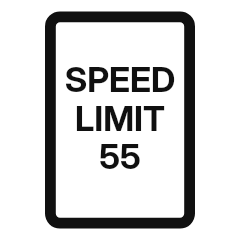
8. On a clear day with light traffic, a driver stays far below the maximum this sign sets. What can that cause?
Show answer
Answer B: Obstruction of the normal flow of traffic, which is prohibited in itself
Driving so slowly that other traffic is impeded is an offense in its own right when nothing about safety, weather or the road calls for it.
-
9. When is a driver or rider most likely to need hand and arm signals instead of the vehicle turn signal lamps?
Show answer
Answer D: When the lamps have failed or cannot be seen because of glare or a load
Hand and arm signals replace or reinforce the lamps whenever the lamps do not work or cannot be seen clearly by other road users.
-
10. A pedestrian signal displays a steady walking person symbol. What does it mean for a pedestrian at that corner?
Show answer
Answer B: The pedestrian may start crossing in the direction of the signal
The steady walking person permits a pedestrian to begin the crossing, while still yielding to vehicles already lawfully in the intersection.
-
11. Which statement about standard drinks is correct?
Show answer
Answer C: A standard serving of beer, of table wine and of distilled spirits each contain about the same amount of pure alcohol
Roughly 12 ounces of regular beer, 5 ounces of table wine and 1.5 ounces of 80 proof spirits each contain about the same amount of pure alcohol, so the type of drink does not change the effect.
-
12. How may a Minnesota driver use a navigation app while the vehicle is in motion?
Show answer
Answer C: By viewing it without holding the device or typing on it
Minnesota Statutes 169.475 permits viewing a global positioning or navigation system as long as the driver neither types on it nor holds it.
-
13. A yellow diamond showing the silhouette of a deer warns that
Show answer
Answer D: large animals may cross the road in that area
The sign marks a stretch where animals are known to cross, so drivers should reduce speed and scan both roadsides, especially around dawn and dusk.
-
14. Which vehicle is exempt from the Minnesota open bottle law?
Show answer
Answer B: A limousine providing commercial service
Minnesota Statutes 169A.35 exempts commercial passenger buses, limousines in commercial service and pedal-powered vehicles carrying five or more passengers.
-
15. How can you tell a tire has reached its wear limit without measuring it?
Show answer
Answer C: The wear bars across the grooves become level with the tread
Molded bars sit at the bottom of the grooves. Once the surrounding tread has worn down to them, the tire has reached the end of its safe life.
-
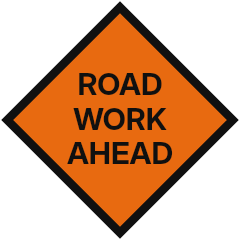
16. Beyond this sign, cones and temporary signs lead traffic along a path that does not agree with the lines painted on the pavement. Which one must the driver follow?
Show answer
Answer C: The temporary arrangement, because it replaces the permanent layout while the work lasts
Temporary traffic control set up for the work takes precedence over the permanent signs and markings, which no longer describe how the road is being used.
-
17. What happens when tires are driven underinflated for a long time?
Show answer
Answer D: They wear at the edges, they run hot and they are more likely to fail
An underinflated tire flexes too much, which wears the shoulders and builds up heat that can destroy the tire.
-
18. A curb sign reads 2 Hour Parking, 8 AM to 6 PM, Monday to Saturday. When may you stay longer than two hours?
Show answer
Answer A: Outside those hours and on Sundays
A time limit applies only during the days and hours printed on the sign; outside them the ordinary parking rules apply.
-
19. You park a manual transmission car facing uphill at a curb. What is the correct combination?
Show answer
Answer A: First gear, wheels turned away from the curb, parking brake set
Facing uphill the car would roll back, so first gear resists that, the wheels turned out let a tire catch the curb, and the parking brake holds it.
-
20. What does Minnesota's hands-free law say about playing a game on a phone while driving?
Show answer
Answer D: It is prohibited, along with accessing other applications
Minnesota Statutes 169.475 bars a driver from accessing video content, audio content, images, games or applications on a wireless device.
-
21. How is organ donor status shown on a Minnesota driver's license?
Show answer
Answer A: The word donor is printed on the front of the card
Minnesota Statutes 171.07 places the designation donor on the front of the license, and that designation is by itself sufficient legal authority for donation.
-
22. The green arrow protecting your turn changes to a steady yellow arrow. What is it telling you?
Show answer
Answer A: The protected turn is ending and you should prepare to stop
A steady yellow arrow warns that the arrow movement is being terminated and that a red indication will follow.
-
23. You are behind three slow vehicles on a two-lane road and the way ahead looks clear. What is the sound decision?
Show answer
Answer D: Pass one vehicle at a time, if the road allows it
Passing several vehicles in one move keeps you in the oncoming lane far too long and leaves nowhere to go if a vehicle appears.
-
24. What should you do as you approach your exit from a roundabout?
Show answer
Answer A: Signal right and check the crosswalk for pedestrians before leaving
A right signal tells following drivers and waiting drivers that you are leaving, and pedestrians cross at the exit leg, so the crosswalk must be checked.
-
25. How far from a school bus with flashing red lights and an extended stop arm must a Minnesota driver stop?
Show answer
Answer A: At least 20 feet
Minnesota Statutes 169.444 requires drivers to stop at least 20 feet from the bus and to stay stopped until the arm retracts and the red lights stop flashing.
-
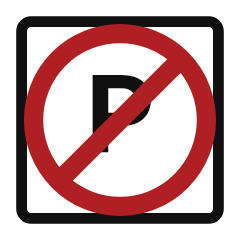
26. Why is this restriction so common beside fire hydrants, crosswalks and intersection corners?
Show answer
Answer C: To keep sight lines open and leave access for emergency crews
A vehicle left in those places hides pedestrians from approaching drivers, blocks the path of turning vehicles and can keep firefighters from reaching a hydrant.
-
27. Travelling at about 55 mph on dry pavement, roughly how much room does an average car need to perceive, react and stop?
Show answer
Answer D: About 300 feet, close to the length of a football field
Reaction distance plus braking distance at 55 mph comes to roughly 300 feet on good dry pavement, and considerably more on a wet or loose surface.
-
28. What is the minimum fine for a Minnesota conviction of driving without the required vehicle insurance?
Show answer
Answer C: 200 dollars
Minnesota Statutes 169.797 requires the court to impose a fine of not less than 200 dollars, and the license may also be revoked for up to 12 months.
-
29. You are descending a long steep grade with a loaded truck close behind you. What should you do?
Show answer
Answer A: Hold a steady speed and let it pass when it can
Gravity pushes a loaded truck downhill and it cannot slow quickly, so give it a predictable speed and room to get by rather than braking in front of it.
-
30. You are traveling at the same speed as a vehicle in the next lane, just behind its rear door. What should you do?
Show answer
Answer B: Change your speed so that you leave that driver's blind spot
That position is the classic blind spot. Slow slightly or move ahead so the other driver can see you before deciding to change lanes.
-
31. How much room must a Minnesota driver leave when overtaking a bicycle going the same way?
Show answer
Answer A: At least three feet
Minnesota Statutes 169.18 requires a safe distance and in no case less than three feet of clearance when overtaking a bicycle.
-
32. You reach a one-lane bridge and a vehicle is already partway across it coming toward you. What should you do?
Show answer
Answer D: Stop before the bridge and let it come through
A vehicle already on a one-lane bridge has the right of way, and the driver who has not yet entered waits at the approach.
-
33. Under Vanessa's Law, when can a Minnesota driver under 18 regain driving privileges revoked for a crash or an alcohol or controlled substance violation?
Show answer
Answer C: Not until the driver turns 18
Vanessa's Law prevents a driver revoked before age 18 for a crash-related moving violation or an alcohol or controlled substance violation from regaining driving privileges until reaching age 18.
-
34. What is the usual result of driving well above the flow of traffic on a typical trip?
Show answer
Answer B: Very little time saved, with much greater risk
Signals, traffic and short distances swallow the theoretical gain, while crash risk and crash severity both climb sharply with speed.
-
35. There is a stop sign but no stop line and no crosswalk. Where must you stop?
Show answer
Answer A: Before entering the intersection, where you can see cross traffic
With no line or crosswalk, stop before you enter the intersection at the point where you can see traffic on the cross street.
-
36. You are waiting to turn left across two oncoming lanes when a driver in the near lane stops and waves you through. What should you do?
Show answer
Answer D: Turn only after checking the far lane yourself
The waving driver cannot give away the right of way of the traffic in the second lane, which may not be stopping at all.
-
37. You back into an unattended parked car in a lot and cause visible damage. What must you do?
Show answer
Answer A: Try to find the owner, or leave a note with your name and contact details, and report the crash
Hitting an unattended vehicle carries the same duties as any crash. Leaving without identifying yourself is a hit-and-run offense.
-
38. A bicyclist stops at a four-way stop just before you do. Who goes first?
Show answer
Answer B: The bicyclist, who reached the intersection and stopped there before you did
A bicyclist on the roadway follows the same right of way rules as a driver, so arrival order decides the turn.
-
39. An ambulance approaches from behind with siren and lights on a two-way Minnesota street. What must the driver do?
Show answer
Answer D: Pull as close as possible to the right curb and stop
Minnesota Statutes 169.20 requires the driver to move parallel to the right-hand edge or curb, clear of any intersection, and to remain there until the emergency vehicle has passed.
-
40. After completing a turn you notice your signal is still flashing. What should you do?
Show answer
Answer A: Switch it off at once, before other drivers act on it
A signal left on after a turn is a false message, and drivers waiting to pull out may move into your path because of it.