
Minnesota DVS Permit Practice Test 9
Test 9 of 10. Pick an answer for each question to see if it is right and why; your score appears at the end. You need 32 correct answers to pass, the same ratio as the real Minnesota test.

- Questions40
- Correct to pass32
- Passing score80%
- Minimum age15 years
-
1. How does a Minnesota driver's license issued to an applicant under 21 differ in appearance?
Show answer
Answer C: It is a different color and is marked Under-21
Minnesota Statutes 171.07 requires under-21 licenses to be of a distinguishing color and plainly marked Under-21.
-
2. How long must a first-time Minnesota applicant aged 19 or older hold an instruction permit before the road test?
Show answer
Answer D: Three months
Applicants aged 19 and older must hold the instruction permit for at least three months, while applicants 18 and younger must hold it for at least six months.
-
3. Which sequence describes a well-made turn?
Show answer
Answer A: Signal, move into the correct lane, slow down, check, then turn
Tell others first, take your position, lose the speed before the corner, take a final look, and only then steer through the turn.
-
4. You are driving at night through heavy falling snow. Which headlight setting works better and why?
Show answer
Answer C: Low beams, because high beams bounce off the falling flakes back at you
Falling snow reflects light the way fog does, so high beams build a white wall of glare while low beams still give a usable view.
-
5. You are stopped in slow traffic and a motorcycle comes up between the lanes. What should you do?
Show answer
Answer D: Hold your position and avoid any sudden lane change
The danger to a rider between lanes comes from a vehicle moving sideways without warning, so staying predictable is what protects them.
-
6. A white regulatory sign shows the silhouette of a truck inside a red circle with a diagonal slash. What does it mean?
Show answer
Answer A: Trucks are not allowed to use that road
The circle and slash over a symbol always means the movement or vehicle shown is prohibited, so trucks must keep off that roadway.
-
7. Traffic safety experts describe three kinds of driver distraction. Which set is correct?
Show answer
Answer A: Visual, manual and cognitive
Distraction takes the eyes off the road, the hands off the controls or the mind off driving, and many activities do more than one of those at once.
-
8. A raised area crosses the roadway and carries a series of white markings on its face. What are those markings for?
Show answer
Answer A: To make the hump visible so drivers slow for it
Speed hump markings warn drivers that the pavement rises, which matters most at night or when the hump is in shadow.
-
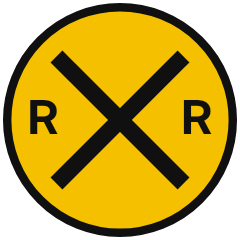
9. This sign leads to a crossing that has no gates and no flashing lights. What does that mean for the driver?
Show answer
Answer D: Nothing will warn of an approaching train, so the driver must check the tracks personally
At a passive crossing there is no active device to announce a train, so the whole judgment rests on the driver, who must approach slowly enough to stop after looking along the track.
-
10. How long after a Minnesota driver's license expires may the holder still renew it?
Show answer
Answer B: One year
Minnesota Statutes 171.27 allows renewal on or before expiration or within one year after expiration.
-
11. When does a Minnesota driver's license issued to a person under 21 expire?
Show answer
Answer D: On the holder's 21st birthday
An under-21 license in Minnesota runs until the holder turns 21, at which point a regular license must be obtained.
-
12. What does a traction control system do?
Show answer
Answer A: It limits wheel spin when you accelerate
Traction control cuts power or brakes a spinning wheel so the tires can grip when you pull away or accelerate on a slippery surface.
-
13. You have passed a large truck and want to move back into its lane. What should you see first?
Show answer
Answer B: Both of its headlights in your rear-view mirror
Seeing both headlights in your mirror means you are far enough ahead to be out of the truck's front no-zone before you move over.
-
14. You come back to find that your parked car has rolled out into the street. What most likely went wrong?
Show answer
Answer C: The parking brake was not set and the wheels were not turned
The parking brake, a gear or park, and turned front wheels are three separate safeguards, and a runaway means at least the first two were missing.
-
15. A snow squall cuts visibility to almost nothing while you are on a highway. What must you not do?
Show answer
Answer D: Stop in a travel lane and wait for the squall to blow through
A vehicle stopped in a lane in a whiteout is invisible until someone hits it. Slow gradually and keep moving until you can leave the roadway completely.
-
16. An entrance ramp joins a highway just before an exit ramp leaves it. What should you expect in that short section?
Show answer
Answer D: Vehicles crossing paths as some enter and others leave
In a weaving section entering traffic moves left while exiting traffic moves right over the same short stretch, so lane changes there need extra room and extra care.
-
17. In a work zone a flagger signals you to stop, but the sign beside the road says the lane is open. What should you do?
Show answer
Answer C: Obey the flagger
A flagger controls the work zone in real time and the instruction outranks the signs and markings, which cannot reflect what is happening at that moment.
-
18. You are traveling in the same direction as a funeral procession and want to get ahead of it. What should you not do?
Show answer
Answer B: Driving in between the vehicles of the procession
Most states prohibit driving into or through a funeral procession, and cutting into the line leaves the drivers behind with no lead vehicle to follow, so go around only where passing is permitted.
-
19. How long does a new Minnesota resident have to register a vehicle already owned when moving to the state?
Show answer
Answer C: 60 days
Minnesota allows new residents up to 60 days after becoming a resident to register their vehicles with Driver and Vehicle Services.
-
20. Which vehicles must display the Minnesota slow-moving vehicle emblem?
Show answer
Answer B: Vehicles designed to operate at 35 mph or less
Minnesota Statutes 169.522 requires the emblem on animal-drawn vehicles, implements of husbandry and other machinery designed for a speed of 35 miles per hour or less.
-
21. A large electronic advertising sign beside the road catches your eye. What should you do?
Show answer
Answer A: Glance briefly and return your eyes to the road
Bright changing displays are designed to hold attention, so treat them like any roadside object and give them no more than a brief glance.
-
22. A line beside your lane is painted about twice the normal width. What does the extra width convey?
Show answer
Answer B: Greater emphasis on the restriction it carries
Width is part of the marking code: a wide line carries more emphasis than a normal one, which is why it is used at gores and channelizing lines.
-
23. You are slowing to turn right at an intersection and a bicyclist is riding beside your right side in a bike lane. What should you do?
Show answer
Answer D: Let the bicyclist go through the intersection before you begin the turn
Turning across the path of a bicyclist who is going straight causes the classic right-hook crash. The rider continuing straight has the right-of-way over your turn.
-
24. You are driving through a long curve on a road with two lanes in your direction. What is correct?
Show answer
Answer A: Stay within your own lane all the way through, adjusting speed before you enter
Wandering out of your lane in a curve puts you into the path of a vehicle you cannot see, and the slowing belongs before the curve rather than in it.
-
25. A Minnesota driver aged 19 shows physical evidence of drinking but is below the impaired driving limit. What happens to the driving privileges?
Show answer
Answer D: They are suspended for 30 days
Minnesota's underage drinking and driving law suspends the license for 30 days, or 180 days if the driver has a prior violation of the same section.
-
26. At roughly what speed can hydroplaning begin when a lot of water is lying on the road?
Show answer
Answer C: At speeds as low as about 35 mph
With enough water and less than perfect tread, a tire can start to ride on the water at around 35 mph, well below normal highway speeds.
-
27. You reach a red light with a sign reading NO TURN ON RED. What may you do?
Show answer
Answer D: Wait for the green; no turn is allowed while the light is red
That sign removes the usual permission to turn on red at the intersection, so you must wait for a green indication.
-
28. A center lane is bordered by a solid yellow line on the outside and a broken yellow line on the inside, with left-turn arrows painted in it. How may you use that lane?
Show answer
Answer A: Only to make a left turn or to prepare for one from either direction
That marking identifies a two-way left turn lane, which may only be used for left turns or to prepare for a left turn and never for travel or passing.
-
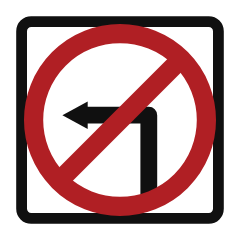
29. No plaque stating days or hours accompanies this sign at the intersection. When does the restriction apply?
Show answer
Answer D: At all times, since nothing limits it to particular periods
A regulatory restriction runs continuously unless a supplemental plaque states the days or hours during which it applies.
-
30. You drive away and the car feels sluggish while a warning light glows on the dash. What is a likely cause?
Show answer
Answer B: The parking brake was left partly applied
Driving with the parking brake partly on overheats the rear brakes and can ruin them, so release it fully and check that the warning light goes out.
-
31. What may the Minnesota commissioner of public safety do to a driver found to be a habitual violator of the traffic laws?
Show answer
Answer D: Suspend the driver's license
Minnesota Statutes 171.18 lists being a habitual violator of the traffic laws as a ground for suspension of the license.
-
32. A pedestrian starts to cross against a Do Not Walk signal, right in front of you. What should you do?
Show answer
Answer D: Slow or stop and let the person reach safety
Even when a pedestrian is crossing unlawfully, a driver must take reasonable care to avoid hitting that person.
-
33. At an intersection where turning on a red arrow is not permitted, the signal shows a red left arrow next to a steady green ball. What may you do?
Show answer
Answer D: Go straight or turn right if permitted, but not left
An arrow controls only the movement it points to, so here the red arrow stops the left turn while the green ball still allows the other movements.
-
34. What weekly cap applies to Minnesota no-fault income loss benefits?
Show answer
Answer B: 500 dollars
Minnesota Statutes 65B.44 compensates 85 percent of lost gross income up to a maximum of 500 dollars per week.
-
35. What must a Minnesota driver be able to produce on the demand of a peace officer?
Show answer
Answer D: Proof of insurance in force for the vehicle being driven
Minnesota Statutes 169.791 requires every driver to have proof of insurance in possession at all times and to produce it on demand.
-
36. How much medical expense benefit must Minnesota no-fault coverage provide for any one person?
Show answer
Answer A: 20,000 dollars
Minnesota Statutes 65B.44 sets basic economic loss medical expense benefits at 20,000 dollars arising out of injury to any one person.
-
37. Besides driver education, what must accompany the instruction permit application of a Minnesota 15-year-old?
Show answer
Answer C: Written approval from a parent or guardian, with proof of age
The statute requires parental or guardian approval and verification of the applicant's age before an under-18 instruction permit is issued.
-
38. An overhead lane-use control signal shows a steady red X above the lane you are traveling in. What does it require?
Show answer
Answer D: Leave that lane, because it is closed to you
A steady red X means road users are not permitted to use the lane beneath it, so you must move into a lane that is open.
-
39. On a regulatory sign, what does a red circle with a diagonal slash drawn over a symbol mean?
Show answer
Answer D: The movement or action shown by the symbol is prohibited
A red circle with a diagonal slash is the standard way of showing that the movement pictured inside it, such as a U-turn or a right turn, is not allowed.
-
40. You are in a minor collision on a busy road. No one is hurt and both vehicles can be driven. What is the recommended thing to do?
Show answer
Answer C: Move the vehicles out of the travel lanes to a safe spot before exchanging information
Vehicles left in traffic after a minor crash invite a second, often worse, collision. Clearing the lane protects everyone, and you still exchange details and report as required.