
Minnesota DVS Permit Practice Test 6
Test 6 of 10. Pick an answer for each question to see if it is right and why; your score appears at the end. You need 32 correct answers to pass, the same ratio as the real Minnesota test.

- Questions40
- Correct to pass32
- Passing score80%
- Minimum age15 years
-
1. In a work zone a flagger is directing traffic in a way that conflicts with the posted signs. Whom do you follow?
Show answer
Answer B: The flagger's directions
A flagger controls traffic through a work area that changes from day to day, and those instructions take precedence over the fixed signs and markings in that zone.
-
2. You notice that the driver ahead of you is holding a phone to the ear. What should you do?
Show answer
Answer C: Assume slower reactions and leave extra space, or else hold back
A driver on the phone reacts late and misses things, so the safe response is distance rather than a lesson.
-
3. A bicyclist is riding around a single-lane roundabout in the middle of the lane as you wait to enter. What is your duty?
Show answer
Answer C: Yield to the bicyclist just as you would to a car
A bicyclist using the roundabout is traffic like any other vehicle and has the same claim to the circulating lane.
-
4. The crossbuck, formed by two rectangular arms crossed in an X, is placed
Show answer
Answer D: on each highway approach to a railroad grade crossing
The crossbuck marks the location of a highway-rail grade crossing and is required on each highway approach to that crossing.
-
5. What habit prevents the hood from flying up while you are driving?
Show answer
Answer D: Press the hood down at the front and check that the latch has caught
Most hoods fly up because they were left on the safety catch, so check that the main latch is fully closed after any work under the hood.
-
6. You are making a legal U-turn at an intersection. Who has the right of way?
Show answer
Answer C: Everyone else, until your turn is complete
A U-turn crosses several paths at once, so you yield to oncoming vehicles, to crossing traffic and to pedestrians before starting it.
-
7. What is the longest period for which Minnesota may suspend a driver's license?
Show answer
Answer C: One year
Minnesota Statutes 171.18 provides that the department must not suspend a license for a period of more than one year.
-
8. How much of a Schedule I or II controlled substance in a Minnesota driver's body supports an impaired driving charge?
Show answer
Answer A: Any amount, or any amount of its metabolite
Minnesota Statutes 169A.20 makes it a crime to drive with any amount of a Schedule I or II controlled substance or its metabolite in the body, subject to limited cannabis exceptions.
-
9. You feel drowsy, so you open a window and turn the radio up. What does that achieve?
Show answer
Answer B: Very little, because the drowsiness comes back
Cold air and loud music are not sleep, so the alerting effect lasts a minute or two and the driver is soon just as sleepy and closer to a lapse.
-
10. You began a turn from the wrong lane and are already inside the intersection. What should you not do?
Show answer
Answer A: Reverse in order to get back into the correct lane
Backing up in an intersection puts you into the path of traffic that cannot expect it; finish the movement and fix your position afterwards.
-
11. What must a Minnesota driver do to regain driving privileges revoked for lack of insurance?
Show answer
Answer A: Pay a 30 dollar reinstatement fee, pass a written test and apply for a new license
Reinstatement requires passing a written test, paying a 30 dollar reinstatement fee plus any court fines, applying for a new license and submitting an insurance certificate.
-
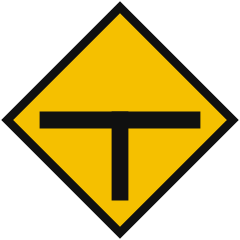
12. On which approach is this sign normally installed?
Show answer
Answer C: On the road that ends, far enough ahead for the driver to slow down
The warning belongs on the approach that terminates, placed early enough that the driver can lose speed and choose a direction before reaching the junction.
-
13. A yellow diamond shows a car with wavy lines behind its rear tires. What is the warning?
Show answer
Answer D: The surface loses grip badly when it is wet
The slippery when wet sign marks a stretch where traction falls off sharply in rain, so speed and braking must be reduced well in advance.
-
14. How many hours of supervised driving must a Minnesota teen log if a parent or guardian completed the approved parent class?
Show answer
Answer A: 40 hours, including 15 at night
With the parent class completed the log requirement is 40 hours including 15 night hours, and without the class it rises to 50 hours including 15 night hours.
-
15. A person with a guide dog is standing at the corner facing the street you are about to cross. What should you do?
Show answer
Answer D: Stop well back and wait quietly for them to decide
Blind pedestrians rely on engine sound to judge traffic, so stop back from the crossing and avoid the horn, which only confuses them.
-
16. What does a NARROW BRIDGE warning sign tell a driver?
Show answer
Answer A: The bridge is tighter than the road leading up to it
A narrow bridge still carries both directions, but with much less clearance than the approaches, so drivers should slow and hold their lane position carefully.
-
17. In a work zone the temporary lane lines conflict with the old lines still visible on the pavement. Which do you follow?
Show answer
Answer C: The temporary markings, which show the current traffic pattern
Temporary markings define the traffic pattern in force, and the old lines are simply the layout that no longer applies.
-
18. In a Minnesota speed zone of 35 mph or less, how far before a school bus stop are the flashing yellow lights activated?
Show answer
Answer D: At least 100 feet
Minnesota bus drivers activate the flashing yellow warning lights at least 100 feet before stopping in a speed zone of 35 mph or less.
-
19. Why should you stay out of an intersection you cannot clear, even on a green light?
Show answer
Answer B: Because you would block cross traffic when their signal turns green
A vehicle stranded in the intersection blocks the cross street when its light turns green, which stalls the whole junction and traps emergency vehicles.
-
20. Which of these is an electronic message under Minnesota's hands-free law?
Show answer
Answer B: A video call placed from one phone to another
Minnesota Statutes 169.475 defines an electronic message to include e-mail, texts, instant messages, images and video calls, but not ordinary voice calls or data transmitted automatically.
-
21. What offense is committed by driving after a Minnesota license has been canceled as inimical to public safety?
Show answer
Answer A: A gross misdemeanor
Minnesota Statutes 171.24 makes driving after cancellation and denial as inimical to public safety a gross misdemeanor.
-
22. Many signs use a symbol instead of words. The main advantage is that a symbol
Show answer
Answer C: can be read from farther away and by more people
A symbol is recognized at greater distance than a line of text and does not depend on the reader knowing English.
-
23. Why are sign shapes and colors standardized across the whole country?
Show answer
Answer D: So a driver knows the kind of message before reading it
Uniform shapes and colors let a driver classify a sign as regulatory, warning or guide from a distance, before the legend can be read.
-
24. What is the Minnesota speed limit on a noninterstate expressway or freeway?
Show answer
Answer D: 65 mph
Minnesota Statutes 169.14 sets 65 miles per hour on noninterstate expressways and noninterstate freeways.
-
25. Where must the supervising driver sit when a Minnesota permit holder under 18 is driving?
Show answer
Answer C: In the seat beside the permit holder
Minnesota Statutes 171.05 requires the instructor, parent, guardian or licensed driver aged 21 or older to occupy the seat beside the permit holder.
-
26. How long can cannabis affect a driver?
Show answer
Answer A: For hours after the strongest effects have passed
Slowed reactions, poor tracking and weak judgment of distance can last for hours, well beyond the point where the user believes the effects are over.
-
27. You have just passed a vehicle on a two-lane road. When may you return to your lane?
Show answer
Answer B: When you can see the whole vehicle in your inside mirror
Seeing the entire vehicle you passed in your rearview mirror shows there is room to pull back in without cutting it off.
-
28. About how far ahead do low beam headlights let you see on a dark road?
Show answer
Answer B: About 250 feet
Low beams light roughly 250 feet of road, and high beams roughly 350 to 500 feet, which sets the limit on a safe night speed.
-
29. What do zero tolerance laws mean for a driver who is under 21?
Show answer
Answer B: They commit a violation at an alcohol level far below the adult limit
Drivers under 21 may not legally drink, so every state sets a limit far below the adult one and treats even a trace reading as a violation. The exact figure is set by each state, and the penalty usually includes losing the license.
-
30. How many passengers under 20 may a Minnesota provisional driver carry during the first six months?
Show answer
Answer A: One
During the first six months only one passenger under 20 is allowed unless a parent or guardian is present, and during the second six months the limit rises to three; immediate family members under 20 are exempt.
-
31. What does Minnesota's basic speed rule require on a road posted at 55 mph during freezing rain?
Show answer
Answer B: Driving no faster than is reasonable and prudent under the conditions
Minnesota Statutes 169.14 forbids driving faster than is reasonable and prudent under the conditions, so the posted limit is a ceiling rather than a target.
-
32. As a general rule, how far should you travel along a center two-way left-turn lane before you turn?
Show answer
Answer C: Only a short distance, just enough to slow down and wait for a gap
The center lane is for making or preparing a left turn, so you enter it only shortly before the turn and never travel along it as a through lane; several states set a specific limit such as 200 or 300 feet.
-
33. You come around a bend and find loose sand spread across your lane. What should you do?
Show answer
Answer D: Ease off the gas, avoid sudden braking or steering, and keep straight
Loose material acts like ball bearings under the tires; smooth inputs preserve what little grip remains, while sudden braking or steering breaks it.
-
34. A stop line is painted across the pavement at this sign. Where must the vehicle come to rest?

Show answer
Answer A: Behind the stop line, with no part of the vehicle across it
The vehicle must halt behind the stop line; where no line is painted the driver stops before the crosswalk, and where there is neither, before entering the intersection.
-
35. You have just passed a large truck on the freeway. Why is it dangerous to pull back in front of it and then brake for your exit?
Show answer
Answer B: A loaded truck needs much more distance to stop than a car
A fully loaded tractor-trailer can need the length of a football field or more to stop from highway speed. Cutting in and braking leaves the driver no room to avoid hitting you.
-
36. What does it mean to cover the brake, and when should you do it?
Show answer
Answer B: Hold your foot over the brake pedal without pressing it when a hazard seems likely
Covering the brake cuts reaction time when you expect trouble, such as near children, parked cars or a vehicle that may pull out. Riding the brake wears it out and confuses drivers behind you.
-
37. Traffic has built up behind you while you wait for a gap to turn left. How should that affect your decision?
Show answer
Answer C: It should not change it; wait for a gap that is genuinely safe
Pressure from behind does not make a small gap bigger, and rushing a left turn across traffic is a common cause of serious crashes.
-
38. What minimum uninsured motorist coverage must a Minnesota policy provide for the death or injury of one person?
Show answer
Answer A: 25,000 dollars
Minnesota Statutes 65B.49 requires uninsured and underinsured motorist coverage of at least 25,000 dollars for one person and 50,000 dollars for two or more.
-
39. In slow summer traffic the temperature gauge climbs into the red. What should you do first?
Show answer
Answer A: Turn off the air conditioner and turn on the heater to draw heat from the engine
The heater core acts as an extra radiator, and shutting off the air conditioner reduces engine load. If the gauge keeps climbing, pull over and shut off the engine, and never open a hot radiator cap.
-
40. You have just returned to your own lane after passing. Why should you not slow down straight away?
Show answer
Answer A: The vehicle you passed is close behind and needs room to stop
Returning and then braking leaves the driver you just overtook with almost no following distance, which is how a pass turns into a rear-end collision.