
Minnesota DVS Permit Practice Test 5
Test 5 of 10. Pick an answer for each question to see if it is right and why; your score appears at the end. You need 32 correct answers to pass, the same ratio as the real Minnesota test.

- Questions40
- Correct to pass32
- Passing score80%
- Minimum age15 years
-
1. A vehicle in front of you has already begun turning left into a driveway when the gap you were waiting for opens up. What should you do?
Show answer
Answer B: Wait and let that driver finish the turn
A vehicle that has lawfully started a maneuver keeps the right of way until it is finished.
-
2. Why is passing on a curve prohibited even when the traffic seems light?
Show answer
Answer C: You cannot see far enough around it to know the lane is clear
A pass is only as safe as the distance you can see, and a curve hides the very lane the maneuver uses.
-
3. The inside of your windshield keeps fogging up on a cold, damp day. What clears it best?
Show answer
Answer B: The defroster with the air conditioning on, which dries the air
Fog on the inside is moisture from the cabin air. The air conditioner dries that air, and the defroster warms the glass, so together they clear it and keep it clear.
-
4. Is it acceptable to watch a video on a screen positioned where you can see it while driving?
Show answer
Answer B: No, the screen pulls your eyes and attention away from the road
Moving pictures are among the strongest visual distractions. Video screens must be out of the driver's view while the vehicle is moving.
-
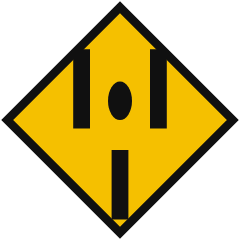
5. What must a driver be ready for beyond this sign?
Show answer
Answer C: Vehicles approaching from the opposite direction in the next lane over
The separation between the two directions runs out, so from that point oncoming vehicles share the same pavement and the driver has to keep right.
-
6. Why is heavy braking a poor idea while two wheels are still on a soft shoulder?
Show answer
Answer B: The two sides have different grip, so the vehicle can pull sharply
With one pair of wheels on pavement and the other on loose material, hard braking slows one side more than the other and swings the vehicle around.
-
7. Which use of a wireless communication device is still legal for a licensed adult driver in Minnesota?
Show answer
Answer D: Using the device in voice-activated or hands-free mode
Minnesota bans composing, reading or sending electronic messages and accessing the internet while driving, but allows voice-activated or hands-free operation and calls for emergency help.
-
8. A flagger turns the paddle to the orange face reading SLOW. What does that tell approaching drivers?
Show answer
Answer D: Reduce speed and continue through the work area with care
The SLOW face keeps traffic moving at a reduced speed while workers or equipment are close to the travel lanes.
-
9. Which passengers do not count against the Minnesota provisional license passenger limit?
Show answer
Answer A: Members of the driver's immediate family
The statute limits passengers under 20 who are not members of the license holder's immediate family.
-
10. When does a child in the vehicle become an aggravating factor in a Minnesota impaired driving case?
Show answer
Answer C: When the child is under 16 and more than 36 months younger than the driver
Minnesota Statutes 169A.03 counts a child under 16 who is more than 36 months younger than the offender as an aggravating factor.
-
11. On a busy multilane highway, where is the best place to travel?
Show answer
Answer B: In a gap in the traffic, with space open on both sides
Travelling in a gap keeps escape routes open on both sides, while riding alongside other vehicles removes the room you would need to swerve.
-
12. You are waiting to turn and the traffic ahead has stopped. Where must you not come to rest?
Show answer
Answer D: On the crosswalk, which people need in order to cross the street
Stopping on a crosswalk forces pedestrians out into the traffic lanes to get around you, so you hold back before it instead.
-
13. Besides the hours from sunset to sunrise, when does Minnesota require headlights?
Show answer
Answer C: When people and vehicles cannot be clearly seen at 500 feet
Minnesota Statutes 169.48 requires lighted lamps whenever weather or other conditions leave persons and vehicles not clearly discernible at 500 feet.
-
14. What is the Minnesota speed limit on an interstate highway inside the limits of an urbanized area?
Show answer
Answer C: 65 mph
Minnesota Statutes 169.14 sets 65 miles per hour on interstate highways inside urbanized areas.
-
15. In a normal signal cycle, what comes after a steady red indication?
Show answer
Answer A: A green indication that starts the next movement
Yellow is a warning that a movement is ending, so it never precedes a green; a red is followed by a green or a green arrow.
-
16. What is the proper use of the horn?
Show answer
Answer C: To give a brief warning when another road user may not have seen you
The horn is a warning device meant to alert someone to your presence when a collision is possible, and using it in anger tends to escalate conflict rather than prevent crashes.
-
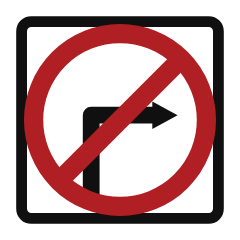
17. A driver stopped at a red signal wants to turn right and this sign is posted at the corner. What is permitted?
Show answer
Answer A: Nothing: the turn is barred whether the signal is red or green
The restriction works independently of the signal, so the usual permission to turn right after stopping at a red light does not exist where this sign is posted.
-
18. You come upon a person riding a horse on the roadway ahead of you. What is the correct way to pass?
Show answer
Answer A: Slow down, give plenty of room and do not use the horn
Horses startle easily, and a frightened horse can throw its rider into your path. Pass slowly and wide, and avoid any sudden noise.
-
19. A center lane is marked with a broken yellow line on each side and is controlled by overhead lane signals. How is that lane used?
Show answer
Answer A: It carries traffic one way or the other according to the signals
A reversible lane is marked with broken yellow lines on both sides and its direction of travel is set by the lane control signals above it.
-
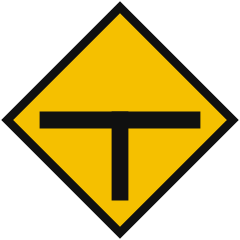
20. What must a driver be prepared to do at the point this sign refers to?
Show answer
Answer D: Turn left or right, because the road being traveled ends there
The road ends at another roadway, so the driver must slow, give way to traffic on the through road and turn in one direction or the other.
-
21. A mixed drink is made with two shots of spirits. How much alcohol is that?
Show answer
Answer C: About two standard drinks
A standard drink is a fixed amount of pure alcohol, so a glass poured with two measures counts as two drinks however it is served.
-
22. Why is a sign reading BRIDGE ICES BEFORE ROAD worth heeding even when the road itself is merely wet?
Show answer
Answer C: Cold air passes under a bridge as well as over it
A bridge deck loses heat from below as well as above, so it can be frozen while the road on either side of it is only wet.
-
23. At what breath alcohol concentration does a Minnesota ignition interlock device block the engine from starting?
Show answer
Answer A: 0.02 or higher
Minnesota Statutes 171.306 defines the device as one that prevents ignition when the breath alcohol concentration measures 0.02 or higher.
-
24. When does a standard Minnesota driver's license expire?
Show answer
Answer D: On the holder's birthday in the fourth year after it was issued
Minnesota Statutes 171.27 sets the expiration date as the driver's birthday in the fourth year following issuance.
-
25. What cell phone use is allowed for a Minnesota driver under 18 who holds an instruction permit or provisional license?
Show answer
Answer C: None, except to call 911 in an emergency
Drivers under 18 with a permit or provisional license may not use a cell phone at all, handheld or hands-free, except to call 911 in an emergency.
-
26. Which statement best describes what the basic speed law requires of you?
Show answer
Answer C: That you never drive faster than is reasonable and safe for the conditions
Nearly every state has a basic speed law that makes the conditions the real limit: weather, traffic, light and road surface can all require a speed well below the posted number.
-
27. Some drivers believe they can multitask while driving. What does research show?
Show answer
Answer C: The brain switches rapidly between tasks and driving performance suffers
The brain does not truly do two attention-demanding tasks at once; it alternates between them, and the driving task gets less attention each time.
-
28. A marked accessible space is signed as van accessible. What is different about it?
Show answer
Answer B: It has a wider aisle for a ramp or a lift to come out
The extra width beside the space is there so a side ramp or lift can deploy and a wheelchair can get clear of the vehicle.
-
29. A driver is following you far too closely and you have a turn coming up. How should you slow down for it?
Show answer
Answer B: Signal early and slow gradually well before the turn
Early signals and gentle braking give a tailgater the time and distance they have failed to leave for themselves.
-
30. Which vehicle must always stop at a Minnesota railroad grade crossing, and where?
Show answer
Answer C: A bus carrying passengers for hire, 15 to 50 feet from the nearest rail
Minnesota Statutes 169.28 requires vehicles carrying passengers for hire, school buses and Head Start buses to stop between 15 and 50 feet from the nearest rail.
-
31. During the second six months of Minnesota provisional licensure, how many passengers under 20 who are not immediate family may the driver carry?
Show answer
Answer C: Three
The passenger limit rises from one passenger under 20 in the first six months to three in the second six months.
-
32. How must a child who is 18 months old be transported in Minnesota?
Show answer
Answer B: In a rear-facing child restraint with an internal harness
Minnesota Statutes 169.685 requires a child under the age of two to ride in a rear-facing child passenger restraint system with an internal harness until the child reaches the seat's weight or height limit.
-
33. A driver moves into the space you were keeping ahead of you. What should you do?
Show answer
Answer D: Ease off and rebuild the gap in front of you
Losing a following gap is common in traffic; the answer is simply to drop back and recreate it rather than drive too close.
-
34. You stop at a rest area because you are sleepy. How long a nap is usually recommended?
Show answer
Answer D: About fifteen to twenty minutes
A short nap of fifteen to twenty minutes restores useful alertness without leaving the grogginess a longer sleep can bring, and you should wait a few minutes before driving on.
-
35. May you park at the curb immediately next to a railroad crossing?
Show answer
Answer A: No, you must leave the crossing and its approach clear
Parking beside a crossing hides the tracks and the signals from approaching drivers and leaves no room for a vehicle that has to clear the rails.
-
36. A bicyclist is riding in the middle of a narrow travel lane ahead of you. What is the correct response?
Show answer
Answer D: Slow down and wait until you can pass with wide clearance, changing lanes if needed
A bicyclist has the same right to use the lane as a driver, and a narrow lane may not leave safe passing room, so wait for a gap that lets you move over and pass with a wide margin.
-
37. What is worth carrying in the vehicle during a winter trip?
Show answer
Answer A: A blanket, a flashlight, a scraper and a small shovel
A winter kit keeps you warm and visible if you are stopped for hours, and lets you clear glass and dig the wheels out. Hot water can crack cold glass.
-
38. How long does Minnesota keep alcohol-related offenses and licensing actions on a driving record?
Show answer
Answer A: Permanently
Minnesota Statutes 171.12 requires records of alcohol-related offenses and licensing actions, and of felonies committed with a motor vehicle, to be kept permanently.
-
39. On the Interstate system, what do the odd-numbered one and two digit routes have in common?
Show answer
Answer D: They run mainly north and south
Odd numbers are given to north and south Interstates and even numbers to east and west ones, with the numbers rising toward the north and the east.
-
40. You decide to turn around using a driveway on your right. What is the safer way to do it?
Show answer
Answer C: Stop past the driveway, reverse into it, then pull out and drive away
Passing the driveway and backing in means you reverse off the roadway and then rejoin traffic facing forward, with a full view of both directions.