
Minnesota DVS Permit Practice Test 3
Test 3 of 10. Pick an answer for each question to see if it is right and why; your score appears at the end. You need 32 correct answers to pass, the same ratio as the real Minnesota test.

- Questions40
- Correct to pass32
- Passing score80%
- Minimum age15 years
-
1. The left-turn signal facing you shows a flashing yellow arrow. What does it mean?
Show answer
Answer C: You may turn left after yielding to oncoming traffic and to pedestrians
A flashing yellow arrow permits a left turn but gives no protection, so you must yield to oncoming vehicles and to people in the crosswalk.
-
2. What does Minnesota law say about wearing headphones while driving?
Show answer
Answer A: It is illegal to wear headphones or earphones in both ears at the same time
Minnesota makes it illegal to wear headphones or earphones in both ears simultaneously to listen to a radio or other sound-producing device while driving.
-
3. What is the minimum age for a Minnesota provisional license?
Show answer
Answer D: 16 years old
A Minnesota provisional license may be issued at age 16 once driver education, the permit period, the driving log and the road test are complete.
-
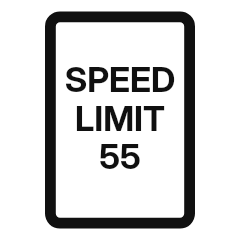
4. Heavy rain has left standing water on the road where this sign is posted. What does the law expect of the driver?
Show answer
Answer C: Driving below the posted figure, at a speed that suits the conditions
Drivers must adapt to conditions, so in rain, fog, snow or dense traffic the safe speed falls below the posted maximum and keeping to that maximum can itself be an offense.
-
5. Why is an underinflated tire especially risky on a long drive in hot weather?
Show answer
Answer C: It flexes more, builds up heat and can fail at speed
A soft tire flexes on every rotation, and that flexing makes heat that the hot road and high speed add to until the tire can come apart.
-
6. A pedestrian steps off the curb in the middle of a block where there is no crosswalk at all. What is the legal position?
Show answer
Answer A: They must yield to you, but you must still avoid a crash
A pedestrian crossing away from a crosswalk yields to vehicles, yet every driver still has a duty to use care and avoid hitting a person.
-
7. What is the minimum Minnesota property damage liability coverage?
Show answer
Answer B: 10,000 dollars
Minnesota Statutes 65B.49 requires at least 10,000 dollars for injury to or destruction of the property of others in any one accident.
-
8. You have turned onto a street and see parked cars facing you and headlights coming toward you. What has probably happened?
Show answer
Answer C: You have turned the wrong way onto a one-way street
Vehicles parked facing you and headlights approaching in your lane are the classic signs of driving against the flow on a one-way street.
-
9. You are driving in the left lane at the posted speed limit and a line of vehicles has built up behind you. What should you do?
Show answer
Answer D: Move into a lane on your right when it is safe and let the traffic behind go by
Most states require traffic moving slower than the flow to keep right and reserve the left lane for passing, so a driver holding up a line of vehicles should move right when it is safe rather than block the lane.
-
10. Four vehicles reach a four-way stop from all four directions at the same instant. How is the deadlock resolved?
Show answer
Answer C: Each driver yields to the vehicle on the right and they go one by one
Yielding to the right applies to every driver, so the group untangles itself as drivers take turns rather than moving together.
-
11. Why is dusk one of the harder times of day to drive?
Show answer
Answer B: The failing light blurs shapes into the background
In fading light there is not enough contrast to pick objects out, yet it is not dark enough for headlights to do the work, so pedestrians and cyclists disappear.
-
12. Under Minnesota's hands-free law, how may a driver listen to audio content on a phone?
Show answer
Answer D: Without scrolling through it or typing on the device
Minnesota Statutes 169.475 lets a driver listen to audio content provided the driver does not scroll or type on the device to do so.
-
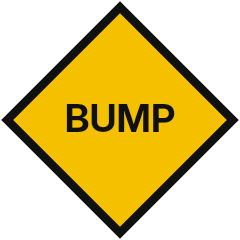
13. Why does this warning matter more on a motorcycle than in a car?
Show answer
Answer B: Because a sudden jolt can unsettle a two-wheeled machine and the rider can lose control
A jolt can push a motorcycle off line or lift a wheel, so a rider slows early, comes slightly off the seat and keeps a relaxed but firm hold on the handlebars.
-
14. Which vehicle is most affected by a strong side wind?
Show answer
Answer D: A van or a car towing a tall trailer
Wind pushes against the side area of a vehicle, so tall boxy shapes and trailers are moved far more than low heavy ones.
-
15. A black on white regulatory sign at an intersection reads NO TURNS. What may a driver do there?
Show answer
Answer B: Only continue straight through the intersection
The NO TURNS sign bans turns in every direction at that intersection, so the only lawful movement from that approach is straight through.
-
16. Apart from giving you room to stop, what else does a longer following gap do for you?
Show answer
Answer D: It widens your view of the road and the traffic ahead
Sitting further back lets you see past and around the vehicle in front, so hazards reach your eyes seconds earlier.
-
17. Two vehicles meet on a steep, narrow mountain road with no room to pass. Which driver should back up?
Show answer
Answer C: The driver heading downhill, who has more control while reversing
On a narrow mountain road the vehicle facing downhill yields, because backing uphill gives better control than reversing down a grade.
-
18. A stalled car sits on a Minnesota shoulder with its hazard warning lights flashing. What must passing drivers do?
Show answer
Answer C: Follow the same move over or slow down duty owed to emergency vehicles
Minnesota Statutes 169.18 extends the move over and slow down duty to a stalled or disabled vehicle that is displaying hazard warning lights.
-
19. Traffic is heavy and crawling where a sign warns that your lane ends and two lanes must become one. What is the best practice?
Show answer
Answer C: Use the lane to the end, then take turns merging one by one
In stop-and-go traffic the zipper merge, using both lanes up to the merge point and then alternating, keeps the queue shorter and traffic moving; in free-flowing traffic move over as soon as it is safe.
-
20. Who may accompany a Minnesota provisional license holder between midnight and 5 a.m. during the first six months?
Show answer
Answer D: A licensed driver who is at least 25 years old
Minnesota Statutes 171.055 permits night driving in the first six months when the provisional holder is accompanied by a licensed driver at least 25 years of age.
-
21. Which vehicle may be driven in Minnesota with only a class D driver's license?
Show answer
Answer B: A single-unit vehicle with a gross vehicle weight rating under 26,000 pounds
Class D is Minnesota's ordinary license and covers single-unit vehicles under 26,000 pounds, along with farm trucks and recreational vehicles within the limits the statute sets.
-
22. How long must a Minnesota driver aged 18 or younger hold an instruction permit before taking the road test?
Show answer
Answer A: Six months
Under the Minnesota graduated licensing system a driver aged 18 or younger must hold the instruction permit for at least six months before the road test.
-
23. Which shape is used for the school advance warning sign and the school crossing sign?
Show answer
Answer B: An upward-pointing pentagon
The five-sided pentagon with its point up identifies school signing, so the outline alone tells a driver that children may be present.
-
24. Does Minnesota's hands-free law apply while a driver waits in a line of traffic at a red light?
Show answer
Answer C: Yes, because the vehicle is a part of traffic
Minnesota Statutes 169.475 applies while a vehicle is in motion or a part of traffic, so a stop at a signal does not lift the restriction.
-
25. You are driving on a road covered with a layer of wet fallen leaves. What should you expect?
Show answer
Answer B: As little grip as on ice, plus hidden markings and hidden holes
Wet leaves are as slippery as ice and they hide the lane lines and any potholes underneath, so slow well before curves and stops.
-
26. You are parking on a one-way street where parking is allowed on both sides. What must still be true?
Show answer
Answer D: The vehicle must face the direction the traffic flows
Either curb may be used on a one-way street where signs allow it, but the vehicle must always be headed in the direction traffic moves.
-
27. A yellow diamond shows an arrow that doubles back on itself. What kind of curve lies ahead?
Show answer
Answer C: A turn of 135 degrees or more, nearly doubling back
The hairpin curve sign is used where the road changes direction by 135 degrees or more, and it is normally backed up by chevrons or a large arrow through the bend.
-
28. You are in a marked passing zone but a steady stream of oncoming traffic is coming toward you. What does the broken center line allow?
Show answer
Answer C: A pass only when the road is clear, so you have to stay behind
A passing zone marks where the sight distance is adequate, but it never gives permission to enter a lane that another vehicle is occupying.
-
29. Which trailer lights must work before you drive away?
Show answer
Answer B: The tail lights, brake lights and turn signals
The trailer hides the vehicle lights from anyone behind, so its own tail, brake and turn signals have to work before you move.
-
30. The light turns yellow when your front wheels are already past the stop line inside the intersection. What should you do?
Show answer
Answer B: Keep going and clear the intersection without speeding up
Once you are legally in the intersection the safest and correct action is to continue through and clear it, without accelerating.
-
31. The sun is low behind you and shining into the eyes of oncoming drivers. What should you do?
Show answer
Answer C: Turn on your headlights and expect oncoming drivers not to see you
Drivers facing the low sun may not see you at all, so make yourself as visible as possible and give way rather than insisting on your right of way.
-
32. Another driver has pulled out to pass you. What should you do?
Show answer
Answer A: Stay in your lane, keep your speed steady or ease off, and let the pass finish
Accelerating while being passed forces the other driver to stay in the opposing lane longer, so the safe response is to hold or slightly reduce speed and stay right.
-
33. Why is a wet road at night harder to read than the same road in daylight?
Show answer
Answer A: The wet surface reflects light away and swallows the lane markings
A film of water sends your headlight beam onward instead of back to you, so lines, edges and people in dark clothing almost disappear.
-
34. You are on a city street with two lanes in your direction, cars parked along the curb and driveways every few yards. Which lane is usually safer?
Show answer
Answer B: The lane farther from the curb, away from opening doors and vehicles pulling out
Most of the hazards on such a street come from the curb side, so the inside lane gives you more space and more time to react.
-
35. Which of these vehicles does the Minnesota Move Over law also protect?
Show answer
Answer A: A postal service vehicle with its warning lights on
Minnesota Statutes 169.18 lists postal service, solid waste and recycling collection vehicles among the authorized vehicles the Move Over duty protects.
-
36. During the first six months with a Minnesota provisional license, when is unaccompanied driving prohibited?
Show answer
Answer C: From midnight to 5 a.m.
For the first six months the provisional driver may not drive between midnight and 5 a.m. unless accompanied by a licensed driver at least 25 years old or covered by the work, school event or employment exceptions.
-
37. The trapezoid sign shape is associated with
Show answer
Answer C: recreational and cultural interest area signing
The trapezoid is used for recreational and cultural interest area guide signs and for national forest route markers.
-
38. How long must a Minnesota driver hold the reduced speed the Move Over law requires?
Show answer
Answer A: Until the vehicle has completely passed the stopped vehicle
Minnesota Statutes 169.18 requires the reduced speed to be maintained until the motor vehicle has completely passed the parked or stopped authorized vehicle.
-
39. A left-turn bay opens ahead of the intersection with a solid white line beside it. Where should you enter the bay?
Show answer
Answer C: At the opening before the solid line begins
The solid line marks where lane changes are no longer intended, so you move into the turn bay at its opening rather than cutting across the line later.
-
40. What is the most common cause of rear-end collisions?
Show answer
Answer C: Following too closely to stop in time
A driver who leaves too little space has no room to perceive, react and brake when the vehicle ahead slows, which is why space management prevents rear-end crashes.