
Minnesota DVS Permit Practice Test 4
Test 4 of 10. Pick an answer for each question to see if it is right and why; your score appears at the end. You need 32 correct answers to pass, the same ratio as the real Minnesota test.

- Questions40
- Correct to pass32
- Passing score80%
- Minimum age15 years
-
1. How should you position your vehicle for a right turn from a two-way street?
Show answer
Answer B: As close as practical to the right curb or edge, then turn into the nearest right lane
Right turns are made from the lane nearest the right edge into the nearest available lane, which keeps the turn tight and prevents a wide sweep into other traffic.
-
2. Under ideal conditions and without posted signs, what is the Minnesota speed limit on urban or town roads?
Show answer
Answer D: 30 mph
Minnesota sets 30 mph on urban or town roads, 10 mph in alleys and 55 mph in other locations unless signs indicate otherwise.
-
3. You are stopped at an intersection where bushes block your view of cross traffic. What should you do?
Show answer
Answer A: Edge forward slowly until you can see, then proceed when clear
Creeping forward a little at a time lets you gain a view without committing to the crossing. Never enter an intersection you cannot see into.
-
4. A sign with a yellow background and a black legend generally conveys
Show answer
Answer B: a general warning
Yellow is the background color used for general warning signs, so a yellow sign tells the driver to expect something ahead rather than to obey a rule.
-
5. Where may an opened container of alcohol lawfully be carried in a Minnesota passenger vehicle?
Show answer
Answer C: In the trunk
Minnesota Statutes 169A.35 allows opened containers only in the trunk or another area not normally occupied by the driver and passengers, and it expressly treats glove and utility compartments as accessible.
-
6. What does a sign reading Slower Traffic Keep Right require?
Show answer
Answer C: Traffic moving slower than the general flow must use the right-hand lane
The sign applies to any vehicle traveling below the speed of the traffic around it, which must keep right so faster vehicles can use the lanes to the left.
-
7. A school crossing guard steps into the roadway and holds up a stop paddle. What must you do?
Show answer
Answer D: Stop and stay stopped until the guard and the children have left the road
A crossing guard directs traffic with legal authority; you must remain stopped until both the guard and the children are clear of the roadway.
-
8. A Minnesota driver approaching a stopped emergency vehicle with flashing lights cannot safely change lanes. What is required?
Show answer
Answer B: Slowing to a speed that is reasonable and prudent until completely past
Minnesota Statutes 169.18 requires a driver who cannot move over to reduce speed to a reasonable and prudent speed until the vehicle has completely passed the stopped authorized vehicle.
-
9. You are already inside an intersection when you realize you should be in the lane beside you. What should you do?
Show answer
Answer C: Stay in your lane through the intersection and change lanes afterwards
Drivers in an intersection are watching for cross traffic and turning vehicles, so an unexpected sideways move there is easily missed.
-
10. Within what range may a Minnesota local authority set a school speed limit?
Show answer
Answer A: 15 to 30 mph
Minnesota Statutes 169.14 lets local authorities establish school speed limits of between 15 and 30 miles per hour in a school zone.
-
11. A driver ahead of you extends the left arm straight out horizontally through the window. What is being signaled?
Show answer
Answer C: A left turn
The left arm held straight out is the standard hand signal for a left turn.
-
12. Another driver is behaving aggressively toward you. What should you do?
Show answer
Answer D: Avoid eye contact, give them room to go on their way and do not respond to provocation
Responding to an aggressive driver escalates the conflict, while creating distance and refusing to engage takes you out of the situation. Report serious threats once you can do so safely.
-
13. Who must supervise a Minnesota instruction permit holder who is under 18?
Show answer
Answer D: A licensed driver aged 21 or older
A permit holder under 18 must be supervised by a licensed driver aged 21 or older seated in the front passenger seat, while a permit holder aged 18 or older may be supervised by a driver aged 18 or older.
-
14. Two left-turn lanes are marked at the intersection and you are in the left one. What must you do?
Show answer
Answer A: Stay in your own lane all the way around the turn
With dual turn lanes each driver must hold a lane through the whole turn and come out in the matching lane of the new street.
-
15. Which alcohol concentration counts as an aggravating factor in a Minnesota impaired driving case?
Show answer
Answer B: 0.16 or more
Minnesota Statutes 169A.03 defines an alcohol concentration of 0.16 or more, measured at the time of the offense or within two hours of it, as an aggravating factor.
-
16. What weekly cap applies to Minnesota no-fault replacement services benefits?
Show answer
Answer C: 200 dollars
Minnesota Statutes 65B.44 caps replacement services loss at 200 dollars per week.
-
17. Which part of the space around your vehicle can you control best?
Show answer
Answer A: The space ahead of you
You choose your own following distance, so the gap in front is the space you truly control and the one that gives you time to react.
-
18. You are very angry after an argument and about to drive. What should you know?
Show answer
Answer A: Strong emotions can impair judgment and attention much like alcohol
Anger, grief and stress pull attention inward and encourage risk taking. Give yourself time to settle down before getting behind the wheel.
-
19. What is the Minnesota speed limit on an interstate highway outside the limits of any urbanized area?
Show answer
Answer B: 70 mph
Minnesota Statutes 169.14 sets 70 miles per hour on interstate highways outside urbanized areas and a lower figure inside them.
-
20. A disabled vehicle is blocking your lane on a two-lane road with a single solid yellow line on your side. What should you do?
Show answer
Answer C: Wait until the oncoming lane is clear, then go around carefully
The solid line prohibits overtaking a moving vehicle, but in most states a driver may go around an obstruction such as a disabled vehicle once the oncoming lane is clear and the move can be made safely.
-
21. How much classroom instruction must a Minnesota applicant under 18 complete before getting an instruction permit?
Show answer
Answer A: 30 hours
An applicant under 18 must complete 30 hours of classroom instruction and be enrolled in behind-the-wheel training, or be in a concurrent course with the first 15 classroom hours finished.
-
22. Must a Minnesota peace officer personally witness a Move Over violation to issue a citation?
Show answer
Answer D: No, a citation may be issued within four hours on probable cause
Minnesota Statutes 169.18 lets an officer issue a citation within four hours of the violation on probable cause, without having witnessed it.
-
23. The light ahead is green, but traffic beyond the intersection is backed up so far that you could not clear it. What is the correct action?
Show answer
Answer D: Wait behind the stop line until there is room on the far side
Entering an intersection you cannot clear blocks cross traffic and pedestrians, so you should hold your position until space opens on the other side.
-
24. You are approaching the entry of a modern roundabout. Who must you yield to?
Show answer
Answer C: Traffic already circulating in the roundabout, which approaches from your left
Traffic in a United States roundabout circulates counterclockwise, so drivers entering must look left and yield to vehicles already in the circulating roadway.
-
25. Traffic is backed up beyond a railroad crossing. When may you start across the tracks?
Show answer
Answer B: Only when there is room for your whole vehicle on the far side
Never enter a crossing you cannot clear; a vehicle stopped on the tracks in a queue has nowhere to go if the signals start.
-
26. You are the first driver on a road just after a storm. What should you plan for?
Show answer
Answer B: Branches, mud and other debris hidden around the next bend
Storm debris lands where nobody has cleared it yet, often just beyond a curve or a crest, so reduce speed and look much further ahead.
-
27. Apart from other vehicles, who else must a driver let go first at this sign?
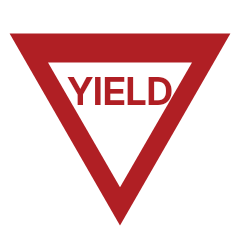
Show answer
Answer A: Pedestrians and cyclists already in or entering the crossing
The duty to give way covers every road user who has the right of way at that point, including people walking or cycling across the driver's path.
-
28. You are turning right onto a one-way street. Which lane of that street should you enter?
Show answer
Answer C: The lane closest to the right curb
Even though every lane on a one-way street runs your way, a right turn must end in the lane nearest the right curb; you may change lanes afterwards when it is safe.
-
29. A traffic signal ahead is showing a flashing red light. What does it require?
Show answer
Answer C: Stop completely, then go when the way is clear, as at a stop sign
A flashing red light has the same meaning as a stop sign: stop completely, yield to traffic and pedestrians, then proceed when it is safe.
-
30. You must leave your vehicle beside a narrow rural road at night. What should you do?
Show answer
Answer B: Get it right off the pavement and switch on the hazard lights
A vehicle left on an unlit rural road is very hard to see, so move it completely clear of the traveled surface and mark it with the hazard lights.
-
31. In which situation should you increase your usual following distance?
Show answer
Answer B: On wet roads, at night, in fog, when towing a trailer, or when following a motorcycle
Reduced traction, reduced visibility, a heavier load and a vehicle that can stop faster than yours all require extra space to keep the same margin of safety.
-
32. A driver slows to walking pace at this sign, never stops rolling and eases into the intersection. How is that treated?

Show answer
Answer B: It is a violation, because the vehicle never came to a complete halt
What is required is a full halt with the wheels no longer turning, so slowing down, however carefully, does not satisfy it.
-
33. Your car is sinking after leaving the road into deep water and two children are in the back. In what order should you act?
Show answer
Answer D: Free yourself from the belt first, then release the children, the oldest one first
You cannot help anyone while you are still belted in, and the oldest child released first needs the least help getting out.
-
34. A white arrow painted in your lane points only to the right, and a sign above the lane shows the same movement. What must you do?
Show answer
Answer C: Turn right from that lane
Pavement arrows used with lane-use signs are regulatory, so a driver occupying that lane must make the movement shown.
-
35. Your tires drop into deep slush that has built up between the travel lanes. What should you do?
Show answer
Answer B: Ease off the accelerator and grip the wheel, since slush tugs the vehicle
Slush grabs at the tires and can pull the vehicle sideways. Reduce power gently, hold the wheel firmly and avoid sudden steering or braking.
-
36. Besides emergency vehicles, which vehicles are covered by the Minnesota Move Over Law?
Show answer
Answer A: Stalled or disabled vehicles and parked service patrol, road maintenance and utility vehicles
The same duty applies when approaching stalled or disabled vehicles and when passing parked service patrol vehicles, road maintenance vehicles and utility company vehicles.
-
37. A wide crosswalk you are turning across has a refuge island in the middle. What should you assume about people standing on it?
Show answer
Answer D: They may step off the island into your path at any moment
An island is a pause in a crossing, not the end of one, so treat anyone on it as a pedestrian who is still crossing.
-
38. You are approaching a sharp curve. When should you reduce your speed?
Show answer
Answer D: Before you enter the curve, so you can accelerate gently through it
Braking hard inside a curve uses up the traction that is already being demanded for cornering, so the slowing must be finished before you enter.
-
39. Alcohol is classified as which kind of drug?
Show answer
Answer B: A depressant that slows the central nervous system
As a depressant, alcohol slows the brain and nervous system, which lengthens reaction time and dulls the coordination that driving depends on.
-
40. In Minnesota, what does reckless driving become when it causes great bodily harm or death?
Show answer
Answer C: A gross misdemeanor
Minnesota Statutes 169.13 makes reckless driving a misdemeanor and raises it to a gross misdemeanor when it causes great bodily harm or death.